
REVIEW · WALKING TOURS
Walking tour of Prague in French : Nové Město
Prague changes character south of Old Town. This French-language walk reveals Nové Město, the 14th-century district Charles IV planned around markets, grand squares, national culture, and the Vltava river. I like the mix of architectural styles, from Gothic and Baroque to Art Nouveau and Cubism, and I like that the route ends beside the river rather than stopping among busy streets. The main consideration is pace: 2.5 hours covers many sites, so you will hear useful context at each stop but will not go inside every major building.
The walk costs $27 per person, a fair price for a live guide, French commentary, local suggestions, and a route that reaches places many first-time visitors skip. It runs in rain, snow, or sunshine, so bring sensible shoes and a weather-ready layer.
In This Review
- Key points about this French walk through Prague
- Why Nové Město makes a strong walking-tour subject
- From Jindřišská Tower to Senovážné Square
- Powder Tower, Estates Theater, and Cubist design
- National identity around the National Museum
- Resslova and the riverfront shift
- Legion Bridge and Park Legií
- What the $27 price gets you
- Who will get the most from this walk
- French commentary and guide quality
- Should you book Walking Tour of Prague in French?
- FAQ
- How long does the French walking tour last?
- What language is the tour conducted in?
- Where does the tour begin?
- How can I reach Jindřišská Tower?
- Where does the tour finish?
- Are hotel pickup and transport tickets included?
- Does the tour run in bad weather?
Key points about this French walk through Prague
- Nové Město was founded by Charles IV in 1348, with Charles Square, Wenceslas Square, and Senovážné Square serving as its three central market areas.
- The route covers a striking range of architecture, including the Powder Tower, Municipal House, Estates Theater, House of the Black Madonna, National Museum, and National Theatre.
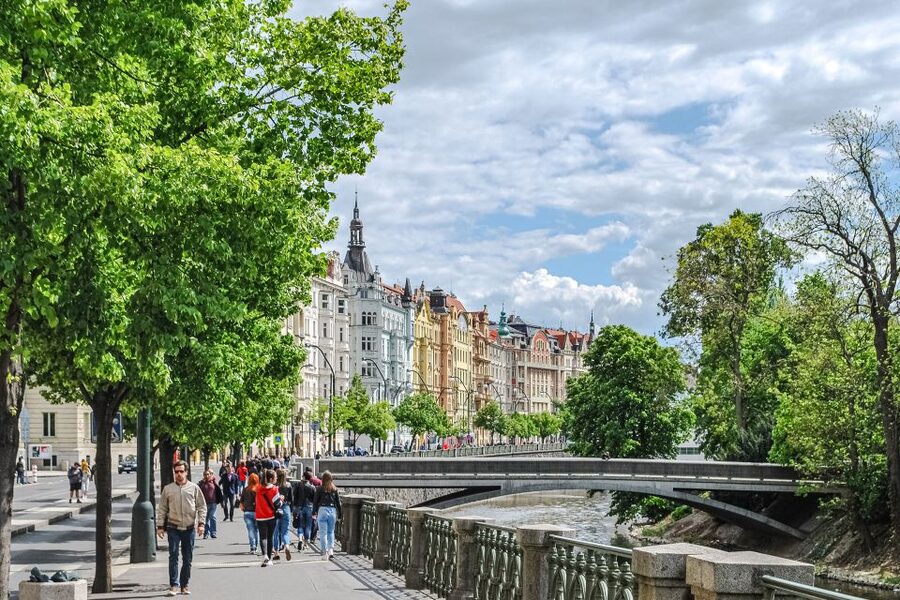
- You walk beside the Vltava, crossing Legion Bridge and finishing in Park Legií near the river.
- The tour is conducted in French, with explanations about Prague’s past, Czech culture, and the country’s national identity.
- Recent Czech history is part of the story, including the Prague Spring and the cultural role of the National Theatre.
- The walk earns a 4.9 rating from 16 reviews, with particular praise for clear, interesting, and captivating explanations.
Why Nové Město makes a strong walking-tour subject
The name New Town can mislead you. Nové Město is not modern Prague in the usual sense. Charles IV established it in 1348, giving medieval Prague a planned district south of the older settlement. Its streets and squares were arranged around practical trade, with separate markets for cattle, horses, and hay.
That plan gives the walk a useful backbone. Instead of hearing a random sequence of dates and buildings, you can follow how the district was organized and how its purpose changed over time. Charles Square served the cattle market, Wenceslas Square the horse market, and Senovážné Square the hay market.
I find this kind of urban story more useful than a simple list of monuments. It helps you read Prague as you walk. A grand square was not created only for decoration. It was part of the city’s daily economy, and later became a setting for political gatherings, national celebrations, and public protest.
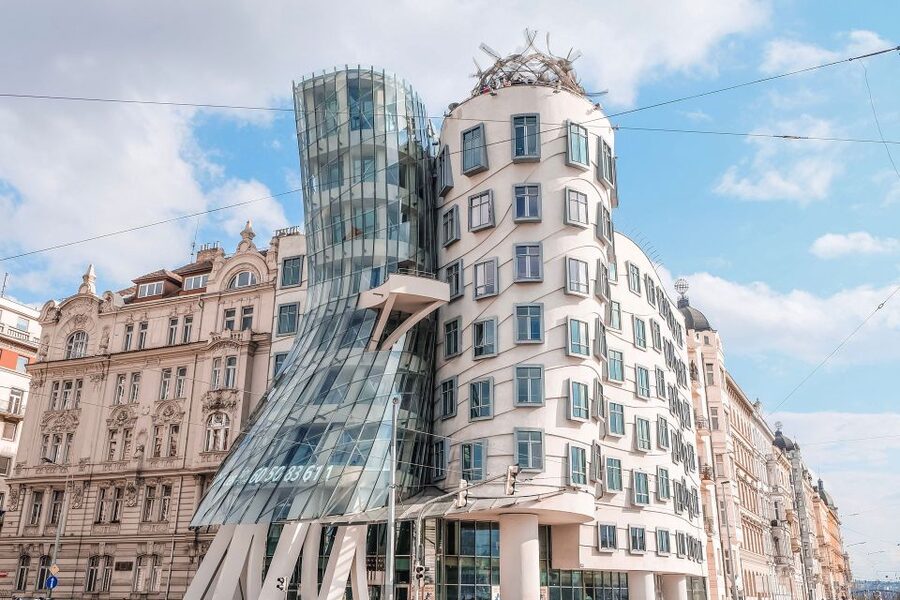
The route also shows how Prague kept adding new styles without wiping away the old ones. Gothic towers sit near Baroque churches and Art Nouveau civic buildings. Cubist design appears in unexpected places. Later, the National Museum and National Theatre express the Czech national revival, while modern architecture near the river points to a much newer Prague.
More walking tours:
- Prague: 3-Hour Walking Tour of Old Town & Prague Castle
★ 4.7 · 5,696 reviews - Prague: Ghost Walking Tour Where Legends Come To Life
★ 4.4 · 5,253 reviews - Prague: Jewish Quarter Walking Tour with Admission Tickets
★ 4.7 · 3,729 reviews
From Jindřišská Tower to Senovážné Square
The meeting point is in front of Jindřišská Tower, a recognizable starting place near the center. Jindřišská tram stop is served by lines 3, 5, 6, 9, 14, and 24, making the beginning relatively easy to reach by public transport.
The first stop is Senovážné náměstí, where the guide spends about 10 minutes. This is the former hay market, one of the three planning centers that explain the shape of Nové Město. It is a good opening because you begin with the district’s purpose before moving on to its artistic and political stories.
From there, the group continues toward Na Příkopě 864. The guided explanation here lasts about 10 minutes. Na Příkopě is one of central Prague’s main commercial streets, but the important point on this tour is the contrast between its present-day role and the medieval market district around it.
The walk then reaches Náměstí Republiky for roughly 15 minutes. This is one of the route’s strongest architectural sections. You can see the Powder Tower and the Municipal House, two buildings from very different chapters of Prague’s story.
The Powder Tower is a Gothic city gate and one of the most recognizable medieval structures in central Prague. Nearby, the Municipal House brings in the decorative energy of Art Nouveau. You do not need to be an architecture specialist to see the change in mood: the tower feels defensive and medieval, while the Municipal House is polished, ornamental, and tied to civic life.
Powder Tower, Estates Theater, and Cubist design
At Ovocný trh, the guide gives another 10-minute explanation. This square is connected to some of Prague’s most important cultural buildings, including the Estates Theater. Mozart performed there, and the theater remains an important part of the city’s cultural identity.
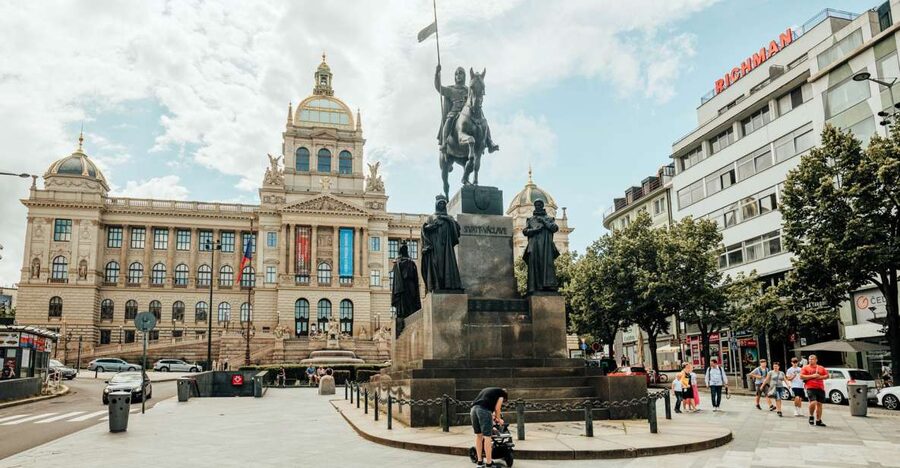
The next stop, at Václavské náměstí 826, continues the architectural tour. The address brings you into the Wenceslas Square area, where the city’s commercial and national roles meet. From here, you reach Jungmann Square for another 10 minutes, then the Franciscan Gardens.
The gardens offer a change of pace. After streets lined with large buildings and traffic, a green public space gives you room to pause. The guide’s explanation here helps connect the formal city squares with smaller places where you can simply sit and watch city life.
A five-minute stop focuses on a sculpture by David Černý. His work is known for humor and provocation, so this is a useful reminder that Prague’s public art is not limited to saints, kings, and historic figures. The brief stop also keeps the walk moving.
You then return to Wenceslas Square for around 10 minutes. This broad space is one of the most important modern public areas in Prague. The tour uses it to explain more than architecture. It is tied to national identity, political events, and the memory of the Prague Spring.
The Prague Spring of 1968 brought an attempt at political reform and greater openness, followed by military intervention. A guide can give this event a human and local setting, rather than leaving it as a date in a history book. Wenceslas Square is one of the places where Prague’s political past becomes easier to picture.
National identity around the National Museum
The route continues toward Sokolská 1595/62 and Na Rybníčku, with about five minutes at each stop. These shorter sections are less about checking off famous monuments and more about keeping the district’s urban story intact as you move south.
You then spend roughly 10 minutes at Charles Square, the old cattle market. It is one of the most important places for understanding Charles IV’s original plan. Today, the square’s scale can feel much larger than the market function suggested by its medieval name.
Charles Square also gives the guide a chance to explain how the district developed beyond its first purpose. It became a major public space, surrounded by layers of architecture and linked to the wider growth of Prague.
The National Museum is one of the key buildings connected with the Czech national revival. The movement used language, education, scholarship, theater, and public institutions to strengthen Czech cultural identity under the Habsburg monarchy. That story matters because it leads toward the creation of Czechoslovakia in 1918.
The walk does not simply present the museum as an impressive facade. It places the building within the long effort to define Czech culture and public life. If you plan to visit the museum separately, this outdoor explanation can make the building more meaningful when you return.
A completely different kind of day out in Prague:
- Prague: 50-Minute Sightseeing Evening Cruise
★ 4.2 · 33,780 reviews - Prague: Medieval Dinner with Unlimited Drinks
★ 4.4 · 19,847 reviews - Prague: Castle Tour with Local Guide and Entry Ticket
★ 4.6 · 10,422 reviews - Prague Castle 2.5-Hour Tour Including Admission Ticket
★ 4.7 · 8,927 reviews
Resslova and the riverfront shift
At Resslova, the guide spends around 10 minutes. The route is now moving away from the market squares and toward the Vltava. This change is important. You see how Nové Město connects the dense inland city with Prague’s riverfront.
Masarykovo nábřeží receives a shorter five-minute stop. Here, the river becomes part of the experience rather than just a view in the background. The Vltava quays offer some of the tour’s best photo opportunities, especially for travelers who want a broader sense of Prague beyond enclosed streets.
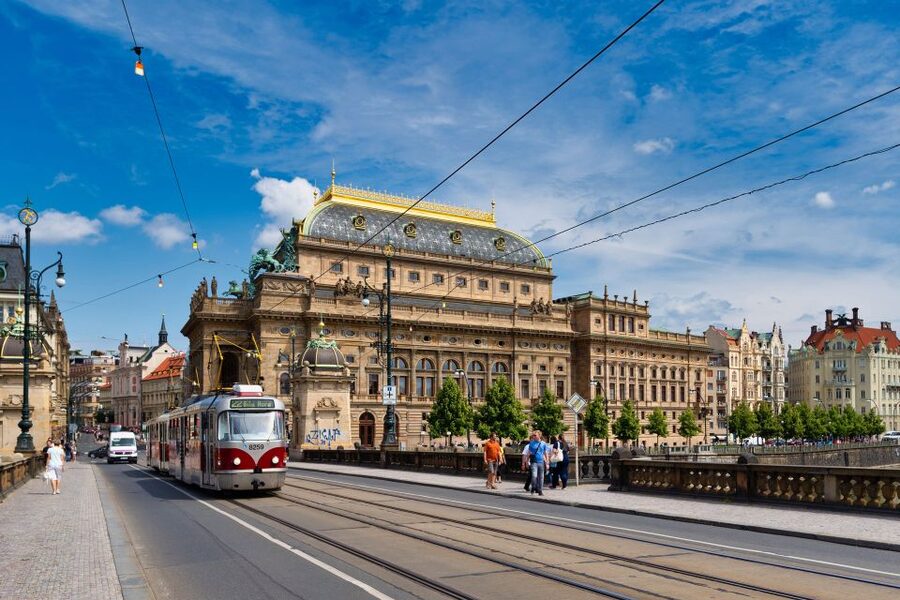
The National Theatre follows, with about 10 minutes of commentary. This is another major building of the Czech national revival and one of the most important cultural institutions in the country. Its role was not merely artistic. The theater represented the ambition to create a major Czech-language cultural institution and strengthen national identity.
For me, this is one of the walk’s most valuable connections. The National Museum and National Theatre are not isolated attractions. Together, they show how architecture, public culture, and political identity worked together before the independence of Czechoslovakia in 1918.
You should not expect a theater performance or an interior visit as part of the walk. The value here is the explanation outside the building, plus the chance to see how it fits into the riverfront and the city’s national story.
Legion Bridge and Park Legií
The final section crosses Legion Bridge, where the guide spends about five minutes. The bridge gives you a new angle across the Vltava and toward Prague’s riverfront architecture. This is a good point to have your camera ready, since the route shifts from close views of buildings to wider city scenes.
The walk finishes in Park Legií, with about 10 minutes of guided commentary. It also includes time on the Archer’s Island area, one of the tour’s more distinctive features. The island and nearby river views provide a calmer ending than a return to a crowded central square.
The route description gives Park Legií as the finishing point, while the meeting information also describes the activity as ending back at the meeting point. Check the final meeting details when you book so you know exactly where the guide will release the group.
This last section is a practical advantage for photographers. You get Gothic towers, grand civic buildings, public art, squares, the National Theatre, bridges, and the Vltava in one continuous walk. The tradeoff is that the route is long in terms of coverage, even though the pace is broken by frequent stops.
What the $27 price gets you
At $27, this is priced as an accessible guided walk rather than a premium private tour. The fee includes a French-speaking local guide licensed by the Czech Ministry of Tourism, about 2.5 hours of walking commentary, explanations of Prague’s history and culture, local addresses, and advice for the rest of your stay.
That advice can improve the value beyond the tour itself. A guide who knows the area can point you toward places to eat, cultural sites, or useful stops nearby. The exact recommendations are not specified, so treat this as an opportunity to ask questions rather than a guaranteed list of establishments.
You pay separately for transport tickets, food, drinks, and hotel pickup or return. These exclusions are easy to manage, but they matter when you plan your morning or afternoon. You need to reach Jindřišská Tower on your own, and you should not count on a vehicle taking you back to your hotel afterward.
The price is especially reasonable if French is your preferred language. A live explanation can make the connections between Charles IV, Czech national culture, the Prague Spring, and modern architecture much clearer than reading brief plaques at each site.
Who will get the most from this walk
I would choose this tour if you have already seen the Old Town’s main streets and want a better understanding of the city south of them. It also works well early in a Prague stay because the guide can give you practical addresses and suggestions for the rest of your visit.
French-speaking visitors are the obvious audience, particularly those who want more than a translated list of dates. The guide discusses Czech culture as well as buildings, so you get context about why the National Museum and National Theatre matter.
Architecture fans will find plenty to enjoy. The route includes Gothic, Baroque, Art Nouveau, and Cubist examples, with the House of the Black Madonna included in the broader architectural story. History-minded visitors will appreciate the links between medieval planning, the national revival, the events of 1968, and independence in 1918.
You should think twice if you dislike walking in all weather or prefer to spend long periods inside museums. This is an outdoor tour, and it operates in rain, sunshine, and snow. You will also want comfortable shoes because the route moves through many city streets and public spaces.
The short explanations at some stops are another point to consider. Five minutes at a location is enough for a focused introduction, but not for a full lecture. The tour favors breadth, connections, and movement over lengthy time at one monument.
French commentary and guide quality
The strongest praise centers on the guide’s explanations. One named guide, Alexandre, is credited with making the visit interesting and captivating, and that is exactly the quality you want on a route with so many historical layers.
The overall rating is 4.9 from 16 reviews, which supports the idea that the experience delivers its central promise. Still, a high rating cannot guarantee the same guide or group dynamic on every departure, so I would judge the tour mainly by its route, language, and subject matter.
The French-language format is a major benefit if you prefer to ask questions and follow complex political or cultural ideas in French. You can also ask the guide for advice about your stay, since local addresses and practical suggestions are included.
Book with the weather in mind. The walk takes place rain, shine, or snow, and there is no indoor alternative stated. A waterproof layer, good footwear, and a small umbrella can make the difference between enjoying the Vltava section and rushing through it.
Should you book Walking Tour of Prague in French?
Book it if you want a well-priced French tour that explains how Nové Město was planned, how Czech national identity developed, and how Prague’s architecture changed across the centuries. The riverfront ending, Archer’s Island, and frequent photo stops give the route more variety than a standard square-to-square city walk.
I would skip it only if you need hotel transport, dislike outdoor walking in poor weather, or want extensive interior visits. For French-speaking visitors who value clear storytelling and a broad view of Prague, $27 is a sensible price for 2.5 hours with a licensed local guide.
Free cancellation is available up to 24 hours before the start, and you can reserve now and pay later. Check the available departure time and the final meeting details before booking.
FAQ
How long does the French walking tour last?
The walking tour lasts approximately 2.5 hours.
What language is the tour conducted in?
The live tour guide conducts the experience in French.
Where does the tour begin?
The tour begins in front of the entrance to Jindřišská Tower.
How can I reach Jindřišská Tower?
The easiest stated option is by tram from Jindřišská station, served by lines 3, 5, 6, 9, 14, and 24.
Where does the tour finish?
The route finishes at Park Legií. The meeting information also says the activity ends back at the meeting point, so check the final details when booking.
Are hotel pickup and transport tickets included?
No. Hotel pickup and return, transport tickets, food, and drinks are not included.
Does the tour run in bad weather?
Yes. The tour takes place in rain, sunshine, or snow, so you should dress for the forecast.
Just added around Prague
- Private Day trip from Prague to Kutná Hora★ 5.0 · 3 reviews
- PRAGUE AIRSOFT SHOOTING GAMES★ 4.7 · 3 reviews
- Private 4-hour City Tour of Prague with driver & official guide w/ Hotel pick up★ 5.0 · 3 reviews
- Glass blowing in Prague★ 4.6 · 3 reviews
- Prague to Karlovy Vary Private Transfer★ 4.5 · 3 reviews
- Disney’s Tarzan Musical★ 5.0 · 3 reviews
- Prague Private Tour★ 5.0 · 3 reviews
- UNESCO Teplice – Premiant eGuide APP★ 4.5 · 3 reviews
Walking Tours, compared.
3-Hour Walking Tour of Old Town & Prague Castle
Read our review →
Ghost Walking Tour Where Legends Come To Life
Read our review →
Jewish Quarter Walking Tour with Admission Tickets
Read our review →
Prague Guided Walking Tour and Cruise with Authentic Czech Lunch
Read our review →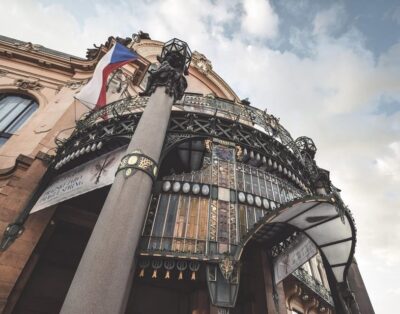
Old Town and Jewish Quarter Guided Walking Tour
Read our review →
Prague Ghost and Legend of Old Town Walking Tour
Read our review →
Prague 3-hour Afternoon Walking Tour including Prague Castle
Read our review →
Ghosts and Legends Nighttime Guided Walking Tour
Read our review →Browse the lists this tour appears in