
REVIEW · PRAGUE
The Plague Doctor of Prague
Dark history makes Prague feel closer. The Plague Doctor of Prague turns a 90-minute evening walk into a theatrical lesson about disease, fear, faith, and daily life in 1715. I like the route through Old Town and the Jewish Quarter, and I like the way guides such as Thomas, David, Oskar, and Maddie mix serious research with dry humor. The main drawback is that the history sometimes gives way to performance, and one guest found the costume’s smell distracting.
This is a small-group experience, capped at 10 people, with an English-speaking plague doctor leading the way. I especially like the final group photograph and the fact that children, teens, medical workers, and history fans can all find something here. You should expect some spooky jokes and old medical practices, though, so it may not suit anyone seeking a quiet architecture tour.
In This Review
- Key points to know before you book
- Why this plague walk works in Prague
- Starting at the House of the Golden Well
- The New Town Hall and the hard logic of quarantine
- Old Town Square, merchants, and war
- Franz Kafka, Jewish life, and the edge of the Jewish Quarter
- Saint Simon and Jude, the old hospital, and early medicine
- Finishing at Saint Agnes of Bohemia
- How much history versus theater?
- Price, group size, and the best time to go
- Who will enjoy the Plague Doctor of Prague?
- Should you book The Plague Doctor of Prague?
- FAQ
- Where does The Plague Doctor of Prague begin?
- Where does the tour end?
- How long does the tour last?
- What language is the tour offered in?
- How much does the experience cost?
- How many people can join the tour?
- Is the tour suitable for most fitness levels?
- What happens if the weather is poor?
Key points to know before you book
- The tour begins at Aurus Hotel, at Karlova 3, and ends near the Convent of St. Agnes in a different part of central Prague.
- Alexander Schamsky and the plague of 1715 provide the main frame for the experience.
- Six stops cover quarantine, medicine, trade, religion, and Jewish life, not just the familiar image of the beaked mask.
- The guides are a major part of the appeal, with Thomas, David, Oskar, and Maddie praised for humor, clear explanations, and staying in character.
- The $26.61 price is fair for a 90-minute guided walk, especially if you want a compact introduction to Prague’s older streets.
- Free cancellation is available up to 24 hours before departure, but poor weather or too few bookings can cause the tour to be rescheduled or canceled.
Why this plague walk works in Prague
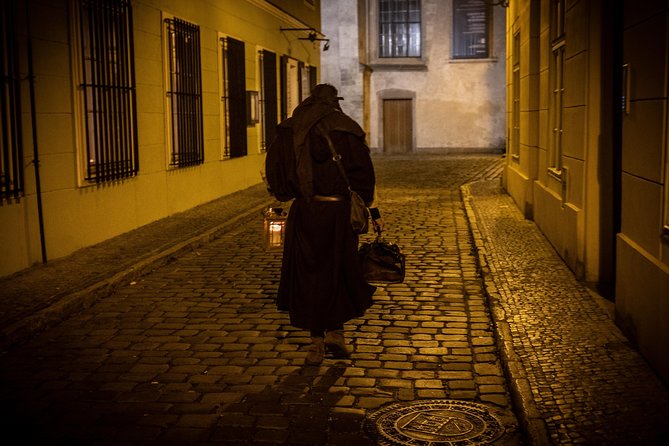
Prague is full of grand churches, old squares, and polished sightseeing routes. This experience takes a different path. Instead of treating the city as a collection of pretty buildings, it asks you to picture what those streets meant when sickness could arrive without warning and medical care offered little protection.
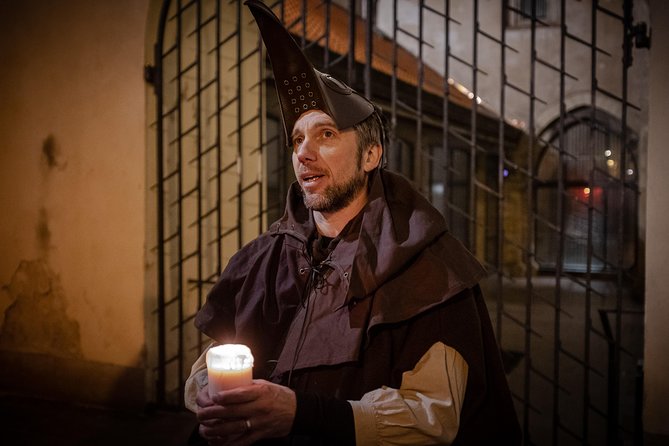
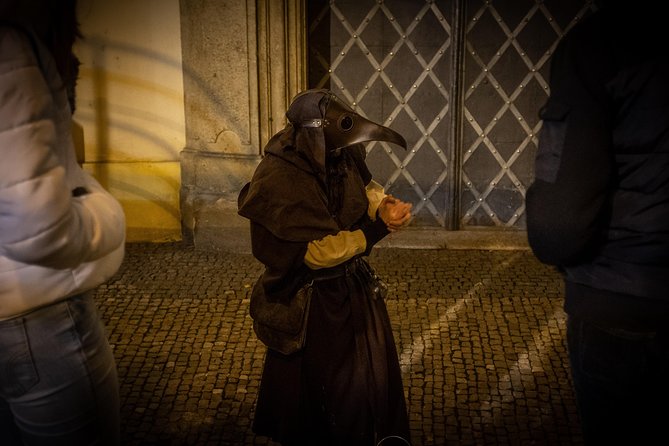
Your guide appears as a plague doctor and introduces Alexander Schamsky, a doctor connected with Prague in 1715. That character gives the tour a clear shape. You are not simply listening to dates while walking from one landmark to another. You are following a figure from the period through places where religion, trade, medicine, and social fear all collided.
The performance helps the facts stick. Several guides have been praised for keeping the tone light without turning the subject into a cheap joke. Thomas is often singled out for his acting and audience care. David is praised for clear explanations and a good sense of humor, while Oskar is described as articulate and well prepared. The quality can depend on who leads your group, but the overall format gives the guide room to make the evening feel personal.
The tour has also received recognition from the New York Times, Vogue, and Forbes. That publicity may explain why it is often reserved about 16 days ahead. I would not treat the awards as a reason to book by themselves, but they do signal that this is more than a person putting on a mask and reciting a few spooky facts.
Other days out in Prague people book alongside this one:
- Prague: 50-Minute Sightseeing Evening Cruise
★ 4.2 · 33,780 reviews - Prague: Medieval Dinner with Unlimited Drinks
★ 4.4 · 19,847 reviews - Prague: Castle Tour with Local Guide and Entry Ticket
★ 4.6 · 10,422 reviews
Starting at the House of the Golden Well
The meeting point is Aurus Hotel Prague, at Karlova 3 in Old Town. The opening ten minutes introduce the building, also known as the House of the Golden Well, before the group turns toward the plague itself.
This is a smart beginning. You get a specific time and place rather than a broad lecture about the Black Death. The guide introduces Alexander Schamsky and sets the clock around 1715, then explains St. Sebastian and St. Rochus, the holy figures associated with protection from plague.
You also hear about the causes people once believed were behind the disease. These ideas could include religious explanations and other theories that now seem strange, but they made sense within the limits of early modern medicine. This section helps you understand that a plague was not only a biological crisis. It was also a crisis of faith, rumor, and public behavior.
The first stop includes a quick outline of the walk ahead. It is brief, so do not expect a long history lesson here. Its job is to set the mood and give you a useful frame for the rest of the evening.
The New Town Hall and the hard logic of quarantine
The second stop lasts about ten minutes and brings in the old monastery Klementinum, its library, and the New Town Hall. The focus shifts from religious belief to the practical question of how different parts of society coped with disease.
You learn about different forms of the Black Death and about the unequal effect of plague on wealthy and ordinary people. Wealth could offer better food, more space, and the option of leaving the city. It could not guarantee safety, but it gave some families choices that poorer residents did not have.
The section on quarantine is one of the most useful parts for modern audiences. You get a look at isolation as a lived condition, not merely a word from a history book. The tour connects public health rules with fear, separation, and the daily struggle to decide whom to trust.
The location also gives you a chance to see how religious and civic buildings shaped Prague’s response to crisis. The stop is short, so the guide has to move quickly. If you want a full architectural tour of Klementinum or the New Town Hall, this is not the right experience. Here, the buildings serve as evidence for a wider story.
Old Town Square, merchants, and war
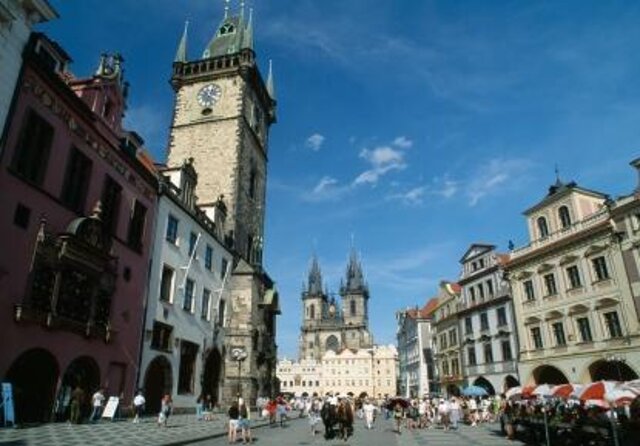
At Staromestske namesti, the tour opens onto Prague’s large market square. The guide points out the Hussite Church, Tyn Church, and Old Town Hall while explaining how merchants lived and worked during plague years.
This is where the experience connects disease with the ordinary economy of the city. A market was a place for food, money, gossip, and contact. Those same connections that kept Prague alive could also spread illness. Merchants faced difficult choices about staying open, traveling, or protecting their families.
The guide also takes an excursion into the Thirty Years’ War. That broadens the story beyond plague alone. War and epidemic could reinforce each other, disrupting supplies, movement, public order, and family life. The stop does not appear designed to provide a complete account of the war, but it helps show that people in Prague faced several forms of danger at once.
You will want to listen closely in this square. It can be a busy public space, and a group of 10 is easier to hear than a large crowd. The small size is a real advantage here, especially when the guide is explaining details while people are moving around you.
A completely different kind of day out in Prague:
- Prague Castle 2.5-Hour Tour Including Admission Ticket
★ 4.7 · 8,927 reviews - Prague: Oldtown, Medieval Underground & Dungeon History Tour
★ 4.2 · 8,244 reviews - Prague: Vltava River Night Cruise with Buffet
★ 4.3 · 7,338 reviews - Prague: Panoramic Vltava River Cruise
★ 4.1 · 7,311 reviews
Franz Kafka, Jewish life, and the edge of the Jewish Quarter
The short stop at the Franz Kafka statue lasts about five minutes. It starts with Kafka, then uses his connection to Prague as a bridge into the Jewish Quarter and the experience of Jewish communities during plague periods.
This is an important part of the tour because plague history often gets reduced to doctors, victims, and statistics. Social blame was also part of the disease story. Jewish communities across Europe could face suspicion and persecution during outbreaks, and the tour gives that subject a place in Prague’s account.
The guide also introduces Albert Camus’s novel La Peste. That literary reference links past epidemics with later thinking about disease, responsibility, and human behavior. It is a quick stop, not a literary seminar, but it adds another layer to the evening.
The short timing is both a strength and a limit. It keeps the walk moving, but anyone hoping for a detailed account of Jewish Prague will need a separate tour of the Jewish Museum and surrounding sites. This experience offers context rather than a full treatment of the quarter.
Saint Simon and Jude, the old hospital, and early medicine
The longest stop is at the Church of Saint Simon and Jude, where the guide discusses the old hospital Na Frantisku. You spend about 15 minutes here, looking at the medical side of the plague and the people who tried to treat it.
This is likely the strongest section for anyone interested in medicine or public health. The guide explains healing methods used at the time and supplies medical background on a disease that killed approximately 200 million people worldwide, according to the tour’s historical framing.
You also hear about lesser-known medical figures who worked at the hospital. That focus on individual doctors and caregivers keeps the subject from becoming a list of grim numbers. It reminds you that hospitals were places of labor, courage, confusion, and limited options.
The old medical practices can be creepy, especially when paired with the costume and evening setting. That is part of the appeal for families with older children and teens, but younger children may react differently. The experience has been enjoyed by children as young as 10, according to one family account, and it has also worked well for adults in medical fields.
Keep your expectations sensible. The tour explains medical beliefs and treatments, but it is not a technical course in bacteriology. Its goal is to make the period understandable and memorable.
Finishing at Saint Agnes of Bohemia
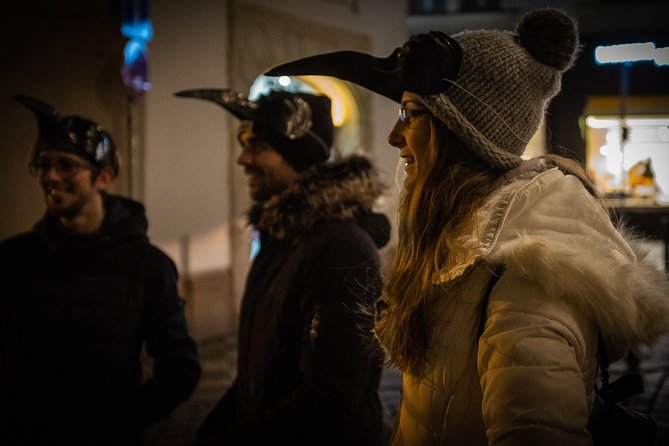
The route ends at the Convent of St. Agnes, now connected with the National Gallery Prague. This final stop introduces Saint Agnes of Bohemia, her life, and her work before drawing together the main ideas from the evening.
Ending at the convent gives the tour a quieter setting after the open squares and streets. It also returns the story to faith and charitable work, themes that appeared at the opening with Saints Sebastian and Rochus.
The guide then covers the current status of plague before taking the group photograph with the plague doctor. The picture is a small but effective finish. You leave with a clear souvenir of the performance, not just a vague memory of standing in another square.
Because the end point differs from the start, check the route before making evening plans. The activity finishes in a separate location near the Convent of St. Agnes, so do not assume you will return to Karlova. The route is described as manageable for most fitness levels, and one four-star account specifically liked that the walk was not too taxing after a long day.
How much history versus theater?
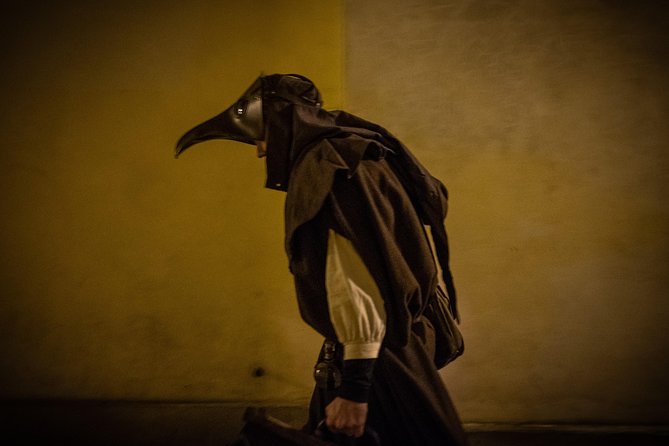
The best guides balance both sides. Thomas is praised for making people feel transported to the period, while David is praised for research, humor, and clear answers to extra questions. Oskar is described as articulate, and Maddie as prepared and personal.
That range matters because the experience depends heavily on presentation. The costume and role-play make the subject easier to remember, especially for families. The humor also prevents 90 minutes about mass death from becoming emotionally exhausting.
Still, the theatrical format has limits. One account found the historical narrative too thin, with plenty of fun facts but not enough structure. That is fair criticism. You will learn about plague beliefs, quarantine, merchants, Jewish life, hospitals, and medicine, but each subject receives a short treatment.
I would describe this as an engaging introduction, not a specialist history course. If you want dates, archival evidence, and a precise account of every outbreak in Prague, choose a formal history lecture or museum visit. If you want a memorable way to connect public health with the city’s streets, this format works very well.
One practical note: a single person complained that the costume smelled and needed refreshing. That appears to be an isolated issue, but it is worth acknowledging because the guide stays physically close to the group.
Price, group size, and the best time to go
At $26.61 per person, the tour offers reasonable value for a 90-minute guided walk in central Prague. You are paying for a live performer, a compact route through several major areas, historical interpretation, and the group photograph. There are no separate admission charges at the stops listed.
The price makes the most sense if you want something beyond a standard Old Town walk. You see familiar places, but the subject changes how you look at them. A market square becomes a place of risk. A church becomes part of a city’s response to disease. A hospital becomes a reminder of how little early doctors could do.
The maximum group size is 10, which should help with questions and hearing the guide. One account describes a group of 12, so actual numbers may vary by departure, but the stated limit is 10. The tour is offered in English and uses a mobile ticket.
The experience requires good weather. If poor conditions cancel it, you are offered another date or a full refund. You can cancel for a full refund up to 24 hours before the start time. Changes or cancellations inside that window are not refunded, and the company may also cancel if too few people book.
It is close to public transportation, and most people can participate. Service animals are allowed. Wear shoes suitable for city streets, and remember that the walk may finish well away from the hotel meeting point.
Who will enjoy the Plague Doctor of Prague?
I would choose this tour for you if you like:
- Public health, medicine, or epidemic history
- Prague’s Old Town but want a new angle on familiar sights
- Live storytelling and light role-play
- Evening walks with a spooky edge
- Family activities that work for adults, teens, and children
- Small groups where you can hear and ask questions
It suits people who enjoy learning through stories rather than long museum labels. The guides keep the tone accessible, and the humor helps younger members stay interested.
You may want to skip it if you dislike costumes, dark subjects, or audience participation. It is also not the best choice if your main goal is architecture. The churches, squares, and streets matter, but they support the plague story rather than receive detailed architectural treatment.
The tour has a 4.9 rating from 126 reviews, with 98 percent recommending it. Those numbers match the strongest pattern in the feedback: the guides make the experience work. The most praised qualities are humor, preparation, clear speaking, and the ability to keep both adults and teenagers involved.
Should you book The Plague Doctor of Prague?
Yes, if you want a short, unusual introduction to Prague that combines history with performance. At $26.61, it is a solid evening choice, especially early in your stay when you are still getting your bearings in Old Town and the Jewish Quarter.
Book it for the storytelling, not for a complete academic account of the plague. Thomas, David, Oskar, Maddie, and other guides have shown how much personality can add to the subject, but the quality of the evening will still depend on the individual performer.
I would especially recommend it to families with older children, medical professionals, history fans, and anyone who has already seen Prague’s main sights and wants a different way to read the city. Check the weather, allow for the separate ending point, and reserve ahead if your dates are fixed. If a creepy but funny lesson in old Prague sounds better than another routine walking tour, this is a good pick.
FAQ
Where does The Plague Doctor of Prague begin?
The tour begins at Aurus Hotel Prague, Karlova 3, 110 00 Praha 1, Staré Město, Czechia.
Where does the tour end?
The activity ends at a different location near the National Gallery Prague and the Convent of St. Agnes of Bohemia.
How long does the tour last?
The experience lasts approximately 1 hour and 30 minutes.
What language is the tour offered in?
The tour is offered in English.
How much does the experience cost?
The listed price is $26.61 per person.
How many people can join the tour?
The stated maximum is 10 people.
Is the tour suitable for most fitness levels?
Most people can participate, and the walk is described as manageable. One account specifically found it suitable after a long day of sightseeing.
What happens if the weather is poor?
The experience requires good weather. If it is canceled because of poor weather, you are offered a different date or a full refund.
Just added around Prague
- Private Day trip from Prague to Kutná Hora★ 5.0 · 3 reviews
- PRAGUE AIRSOFT SHOOTING GAMES★ 4.7 · 3 reviews
- Private 4-hour City Tour of Prague with driver & official guide w/ Hotel pick up★ 5.0 · 3 reviews
- Glass blowing in Prague★ 4.6 · 3 reviews
- Prague to Karlovy Vary Private Transfer★ 4.5 · 3 reviews
- Disney’s Tarzan Musical★ 5.0 · 3 reviews
- Prague Private Tour★ 5.0 · 3 reviews
- Private Bohemian Glass and Czech Crystal Tour with lunch included★ 5.0 · 3 reviews