
REVIEW · PRAGUE
Taste, Cook and Dine Traditional Czech
Prague tastes better from a kitchen table. This three-and-a-half-hour class brings Czech food, family recipes, local drinks, and cultural stories together in a small setting. I like the hands-on cooking, especially the chance to prepare bread dumplings and a seasonal starter, and I like the steady stream of tastings, wine, and conversation. The main consideration is the price: at $167.75 per person, this is a full food experience rather than a quick cooking lesson.
You meet at Křižíkova 70/67 in Karlín, a location near public transportation, and finish back there. Hosts Bret and, on some occasions, his sister Svetlana, lead the evening. The group is limited to eight people, which matters here because the best part is taking part, not sitting at the edge of a demonstration.
In This Review
- Key points to know before booking
- A Czech food lesson that feels like supper with friends
- What happens during the 3.5-hour evening
- 1. Start with Czech delicacies
- 2. Prepare a traditional starter
- 3. Learn the bread dumpling method
- 4. Sit down to the main course
- 5. Finish with dessert and fruit brandy
- Three Czech wines give the meal a local frame
- Why the small group size changes the experience
- Is $167.75 a fair price?
- Who will enjoy this most?
- Practical details that matter
- Should you book Taste, Cook and Dine Traditional Czech?
- FAQ
- How long does the Czech cooking experience last?
- Where does the experience start?
- Where does the experience end?
- Is the experience offered in English?
- How many people can join the class?
- What food will I taste?
- Which dishes might I help prepare?
- Is the main course cooked during the class?
- Are drinks included?
- Can I cancel for a full refund?
Key points to know before booking
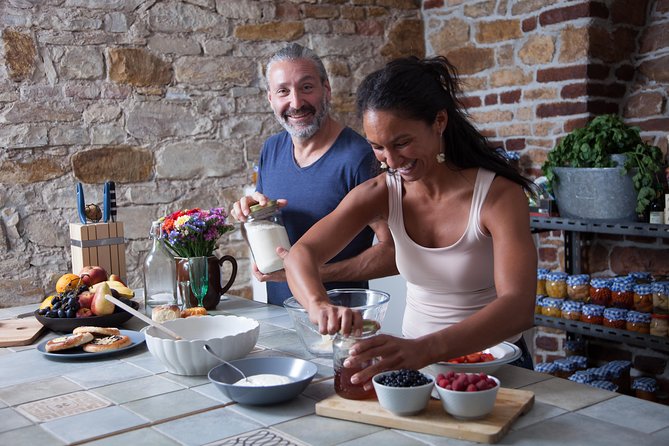
- A full Czech meal, not just a cooking lesson: You taste snacks, help prepare several dishes, and finish with a host-prepared main course and dessert.
- Bread dumplings are part of the lesson: You help make a classic Czech side dish that gives the meal its proper local character.
- Three Czech wines and fruit brandy: The drinks are built into the evening, with a focus on Moravian wine.
- The menu changes with the season: Expect different vegetables, fruit, starters, and desserts depending on what is available.
- Small groups make participation easier: The maximum is eight people, and past evenings have included groups as small as three.
- A social, story-filled setting: Cooking, music, food history, and conversation are treated as equally important parts of the experience.
A Czech food lesson that feels like supper with friends
The appeal here is simple. You do not just hear a guide list Czech dishes, then walk away hungry. You taste ingredients, help prepare food, ask questions, drink local wine, and sit down to eat what has been made.
The hosts use food to explain Czech life. You learn what has commonly appeared in Czech homes, what local people grew and farmed, and how those ingredients became familiar dishes. That gives the meal useful context. A potato or cabbage dish is no longer just something on a plate. It becomes part of a story about household habits, regional farming, and the way food shaped daily life.
Bret is the main host named in the feedback, and his role seems to be central to the evening’s success. You can expect a warm, humorous approach rather than a formal chef’s demonstration. Past sessions have also been led by Bret and Svetlana together.
The atmosphere is relaxed. One description places the class in a historical basement space, with music, wine, and a cozy dining setup. Exact room details may vary, but the important point is that this is designed as a shared meal in a personal setting, not a large commercial cooking studio.
Other days out in Prague people book alongside this one:
- Prague: 50-Minute Sightseeing Evening Cruise
★ 4.2 · 33,780 reviews - Prague: Medieval Dinner with Unlimited Drinks
★ 4.4 · 19,847 reviews - Prague: Castle Tour with Local Guide and Entry Ticket
★ 4.6 · 10,422 reviews
What happens during the 3.5-hour evening
The order can change with the season and the group, but the experience follows a clear rhythm: taste first, cook along the way, then sit down to a substantial Czech meal.
1. Start with Czech delicacies
The opening spread introduces you to the kinds of foods that may not be obvious from a restaurant menu. You can taste sausages, cheeses, homemade jams, pickles, bread, seasonal vegetables, and fruit.
This is a good beginning because it lets you sample several flavors before committing to a full dish. Pickles and preserves show how food has been kept and served at home. Sausages and cheeses give you a sense of the everyday table. Bread provides a useful bridge to the dumpling lesson later.
The assortment is not fixed. It changes with the season and the products available. That is a plus if you want a food experience tied to the time of year, although it means you should not book expecting every item in the sample menu.
2. Prepare a traditional starter
The hands-on starter may be a potato and sauerkraut pancake, a quark cheese spread, or a carrot and kohlrabi salad. You prepare one of these with typical Czech ingredients while the host explains how it fits into local cooking.
The potato and sauerkraut pancake sounds like the most active option. One account describes cheese being grated and potato pancakes being flipped, so you should expect practical kitchen work rather than simply stirring a bowl. The quark spread and vegetable salad offer a gentler task, but still show how simple ingredients are turned into a dish with a clear Czech identity.
Seasonality matters here. A fresh vegetable dish may be more likely at one time of year, while a potato-based starter may suit another. The flexible menu keeps the class connected to real cooking, though it also means you cannot choose the exact starter in advance.
A completely different kind of day out in Prague:
- Prague Castle 2.5-Hour Tour Including Admission Ticket
★ 4.7 · 8,927 reviews - Prague: Oldtown, Medieval Underground & Dungeon History Tour
★ 4.2 · 8,244 reviews - Prague: Vltava River Night Cruise with Buffet
★ 4.3 · 7,338 reviews - Prague: Panoramic Vltava River Cruise
★ 4.1 · 7,311 reviews
3. Learn the bread dumpling method
Bread dumplings are one of the most useful parts of the class. You help prepare them as the side dish for the main course, and the lesson gives you a practical look at a food that is central to many Czech meals.
Dumplings are not a minor garnish in this tradition. They are made to absorb sauce, which is why they work so well with dishes such as svíčková and goulash. Learning to prepare them helps you understand the structure of the meal, not just one recipe.
A few comments about making different kinds of dumplings suggest that this part can become one of the most memorable kitchen tasks. It is also a recipe you can try again at home, provided you are willing to measure, mix, and practice.
4. Sit down to the main course
The main dish is prepared in advance by the host, so you are not responsible for cooking every part of dinner. That is a sensible choice. It allows the evening to include a properly finished traditional dish while you spend your time working on the recipes that teach the most.
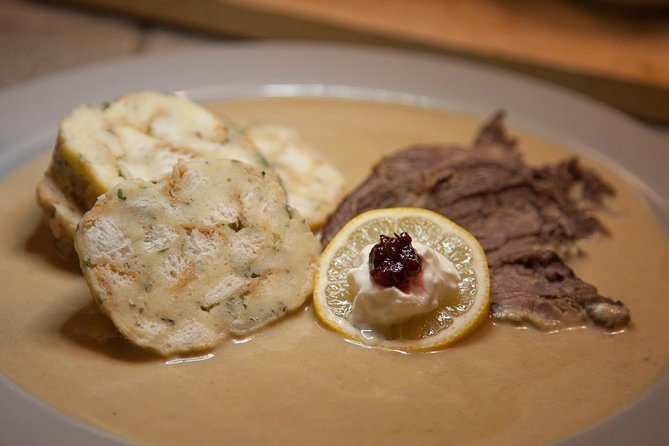
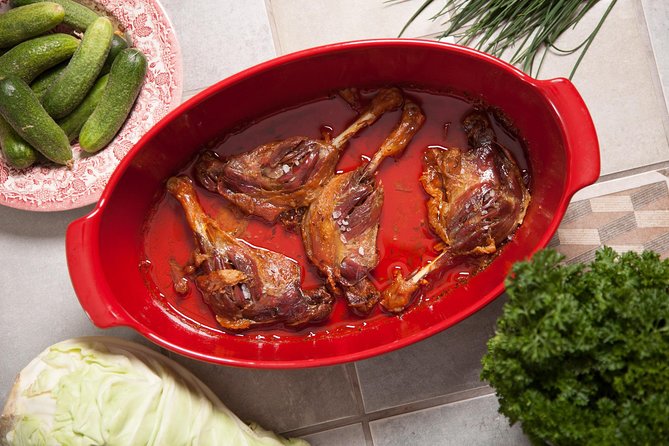
Possible mains include svíčková, beef goulash, Spanish bird, roasted duck, rabbit with vegetables, or beef with mushrooms. The menu does not promise all of these. Instead, you receive one traditional main based on the date and the host’s plan.
Svíčková is beef served with a creamy vegetable sauce, while goulash offers a darker, more robust style of Czech comfort food. Spanish bird is a stuffed beef roll, despite its name, and roasted duck or rabbit gives the meal a different feel again. The range shows that Czech cooking is not limited to one heavy dish.
The bread dumplings are served alongside the main. This is where the earlier work pays off. You can taste the dumplings with the sauce and understand why they remain such a familiar part of Czech cooking.
5. Finish with dessert and fruit brandy
Dessert may be fruit dumplings or kremrole. Fruit dumplings are filled with fresh seasonal fruit and served with poppy seeds, quark, or both. Kremrole is a delicate pastry filled with sweet meringue.
These are very different endings. Fruit dumplings are soft and home-style, while kremrole brings a lighter pastry finish. Again, the exact choice depends on the season and the host.
You also taste a sample of Czech fruit brandy. It is a small part of the evening, but it rounds out the food lesson by showing another traditional drink beyond wine.
Three Czech wines give the meal a local frame
Wine is not an afterthought here. You taste three Czech wines during the experience, with particular attention to wine from Moravia. The tasting gives you something to compare as you move from small snacks to the main dish.
That is useful in Prague, where visitors often associate Czech drinking culture mainly with beer. This class points you toward another part of the country’s food and drink identity. The wine is served as part of the meal and conversation, not as a separate technical tasting.
You should not expect a formal wine certification lesson. The value is in trying several bottles while the host talks about the food, the region, and the pairing. If you like learning through eating and conversation, this approach will suit you.
Because wine and fruit brandy are included, this class may not be ideal for someone avoiding alcohol. The supplied details do not state whether nonalcoholic alternatives are available, so contact the provider before booking if that matters to you.
Why the small group size changes the experience
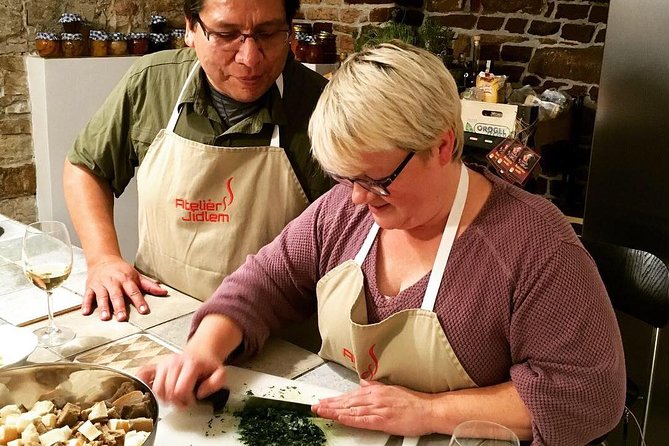
The maximum group size is eight. That is small enough for people to take turns with the food, speak directly with the host, and avoid the impersonal feel of a large class.
The group can be much smaller. One evening had only a solo participant and a couple, while another had five people. That creates a useful choice: solo visitors can meet people without joining a crowd, and couples or families can still receive plenty of attention.
A small group also makes the social side more natural. You are likely to spend a good part of the evening talking while food cooks or is served. If you prefer to stay completely private, this may feel more social than you want. One participant even realized after booking that the session was private, but still found it enjoyable. Check your booking details if the size of the group matters to you.
Is $167.75 a fair price?
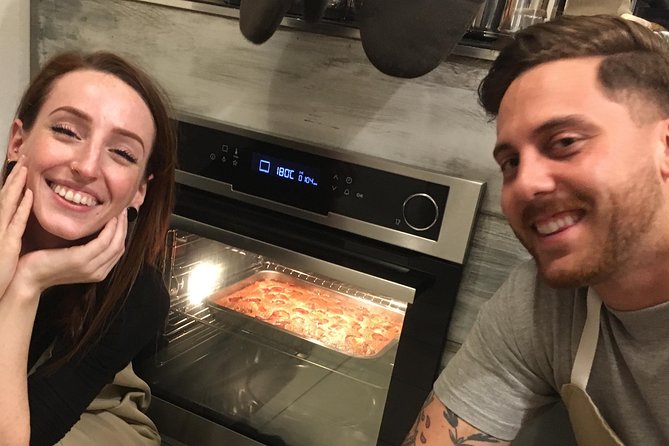
At $167.75 per person, this is expensive compared with a short market tasting or a basic one-dish cooking class. You are paying for about three and a half hours, a full meal, multiple tastings, three wines, fruit brandy, instruction, and a small group.
The value improves if you treat it as both dinner and a cultural activity. You do not need to buy a separate evening meal, and the class fills a substantial part of your schedule. You also receive more than a plate of food: the host explains ingredients, cooking habits, and the place food holds in Czech culture.
The price is easiest to justify for food-focused visitors, solo visitors seeking a social evening, and anyone who usually books a cooking activity in each city. It is harder to justify if you are mainly looking for a cheap meal, dislike group participation, or have little interest in cooking.
The strong satisfaction record is also worth noting. The experience has a five-star rating from 58 reviews, with 100 percent recommending it. That does not remove the need to consider your budget, but it does point to a consistently well-received format.
Who will enjoy this most?
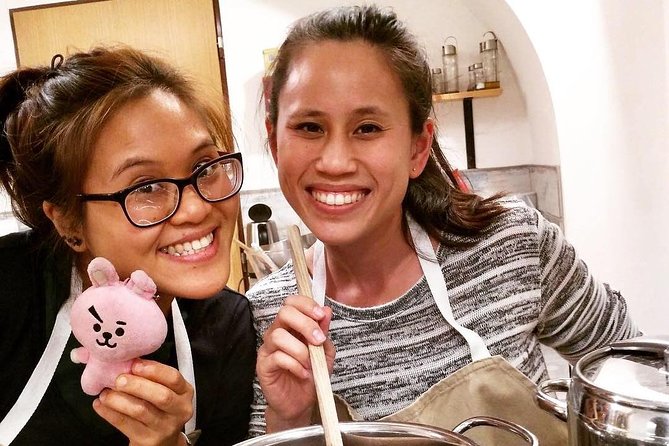
I would put this high on the list for:
- Food lovers who want more than restaurant dining
- Visitors curious about Czech household cooking
- Solo visitors who want a friendly small-group evening
- Couples and families looking for a shared activity
- People who enjoy wine with dinner
- Anyone who wants to learn a few recipes to try at home
It also suits repeat visitors to Prague. If you have already seen the major sights, a kitchen-based evening gives you a different way to understand the city and country.
Children may enjoy the hands-on tasks, but the supplied information does not give an age policy or child pricing. Ask the provider before booking for a young family member.
Practical details that matter
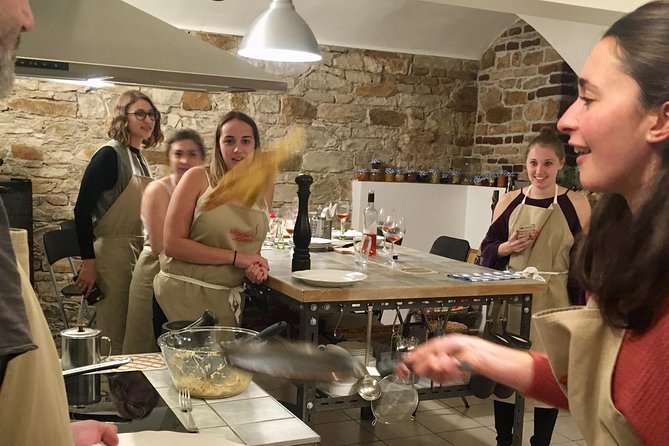
The class starts at Křižíkova 70/67 in Prague 8, Karlín, and ends at the same meeting point. The location is near public transportation, which makes it easier to reach without arranging a private transfer.
The experience is offered in English and includes a mobile ticket. It is wise to allow enough time to reach Karlín before the start, since the cooking schedule is built around the group arriving together.
Book ahead if your Prague dates are fixed. The activity is booked, on average, 50 days in advance, which suggests that waiting until the last day may not work for a preferred date.
You receive confirmation at booking. Free cancellation is available up to 24 hours before the start time for a full refund. Changes or cancellations inside that 24-hour window are not accepted for a refund. The experience also needs a minimum number of participants, and if that minimum is not met, you are offered another date or experience, or a full refund.
Should you book Taste, Cook and Dine Traditional Czech?
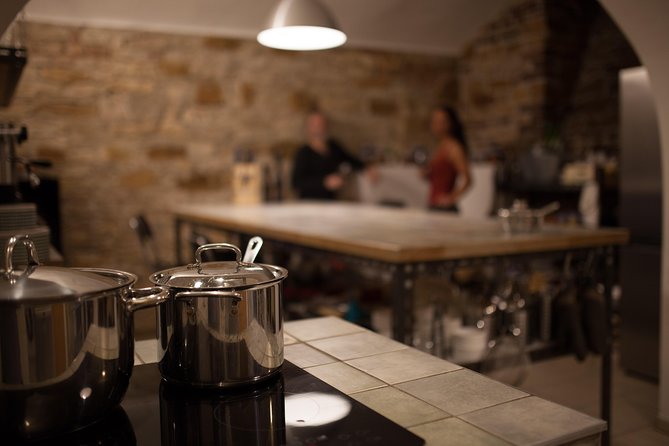
I would book it if you want an evening built around food, conversation, and local tradition rather than a quick cooking demonstration. The strongest reasons are the tiny group, the practical dumpling and starter work, the spread of homemade foods, and the chance to taste Moravian wines alongside a full Czech meal.
I would skip it if you want a low-cost meal, a fixed menu, or a highly technical chef’s class. The menu changes, the main dish is prepared in advance, and the evening depends as much on the host and group conversation as it does on cooking.
For most food-minded visitors, this looks like one of the better ways to spend an evening in Prague. Come ready to taste unfamiliar foods, take part in the kitchen, and share a table. At this price, the social setting and personal hosting need to be part of what you want. If they are, the class has the makings of a memorable night.
FAQ
How long does the Czech cooking experience last?
It lasts approximately 3 hours and 30 minutes.
Where does the experience start?
It starts at Křižíkova 70/67, 186 00 Praha 8-Karlín, Czechia.
Where does the experience end?
It ends back at the meeting point.
Is the experience offered in English?
Yes. The experience is offered in English.
How many people can join the class?
The maximum group size is eight people.
What food will I taste?
You may taste sausages, cheeses, homemade jams, pickles, bread, seasonal vegetables, and fruit, followed by Czech starters, a main dish, a side dish, and dessert.
Which dishes might I help prepare?
Depending on the season, you may help prepare a potato and sauerkraut pancake, quark cheese spread, carrot and kohlrabi salad, bread dumplings, or a dessert.
Is the main course cooked during the class?
The main course is prepared by the host in advance. You help prepare other parts of the meal, including the side dish and a seasonal starter.
Are drinks included?
Yes. You taste three Czech wines and a sample of Czech fruit brandy.
Can I cancel for a full refund?
Yes, if you cancel at least 24 hours before the experience start time. Cancellations made less than 24 hours before the start are not refunded.
Just added around Prague
- Private Day trip from Prague to Kutná Hora★ 5.0 · 3 reviews
- PRAGUE AIRSOFT SHOOTING GAMES★ 4.7 · 3 reviews
- Private 4-hour City Tour of Prague with driver & official guide w/ Hotel pick up★ 5.0 · 3 reviews
- Glass blowing in Prague★ 4.6 · 3 reviews
- Prague to Karlovy Vary Private Transfer★ 4.5 · 3 reviews
- Disney’s Tarzan Musical★ 5.0 · 3 reviews
- Prague Private Tour★ 5.0 · 3 reviews
- Ebike tour in Prague – Express Tour★ 5.0 · 3 reviews