
REVIEW · WALKING TOURS
Private Prague Art Nouveau and Cubism Walking Tour
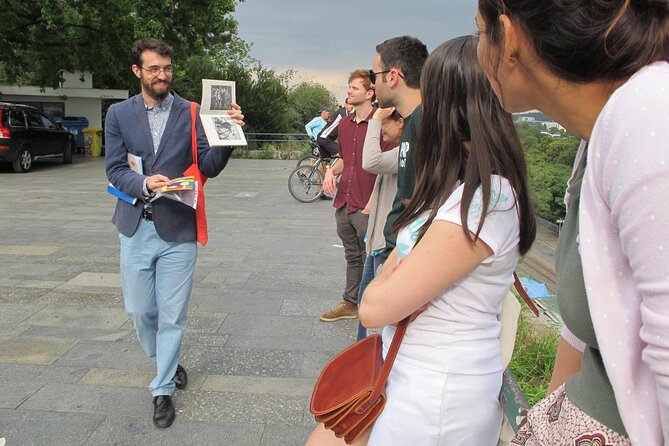
Art hides in plain sight. This private Prague walk shifts your attention from medieval towers to the Art Nouveau and Cubist buildings of the early 20th century, when Prague was looking toward modern Europe. I like the focused route, which links grand public buildings with cafés, arcades, a railway station, and a witty modern statue. I also like the private format: your guide can adjust the pace and explain details that are easy to miss alone. The main consideration is simple: three hours means plenty of walking, with limited time inside each stop.
The tour costs $396.46 for a group of up to 10 people, so the value improves sharply when you fill the group. A historian leads the walk in English, and pickup may be arranged, though the standard meeting point is Grand Café Orient. Guides such as Robert Wesley and Bonita have received especially warm praise for mixing architecture with Czech history and personal stories.
In This Review
- Key points to know before you book
- Why Prague’s modern face deserves three hours
- Starting at the House of the Black Madonna
- Obecní Dum turns architecture into national pride
- K+K Hotel Central and the first Art Nouveau signal
- Café Imperial gives the style an interior
- The Czechoslovak Legion Bank brings Cubism back
- Prague Main Train Station and its magnificent dome
- Wenceslas Square links Art Nouveau and Art Deco
- Lucerna Arcade and a surprising final sculpture
- What the private format is really worth
- Guides, walking pace, and who should book
- Booking details worth keeping in mind
- Should you book this Prague architecture walk?
- FAQ
- How long does the private Prague Art Nouveau and Cubism tour last?
- How much does the tour cost?
- Is the tour private?
- Is the tour offered in English?
- Who leads the tour?
- Where does the tour start?
- Is hotel pickup included?
- Are food and drinks included?
- Can I cancel for a full refund?
Key points to know before you book
- House of the Black Madonna: Begin with Prague’s striking Cubist experiment, a building that looks angular, bold, and unlike the older architecture around it.
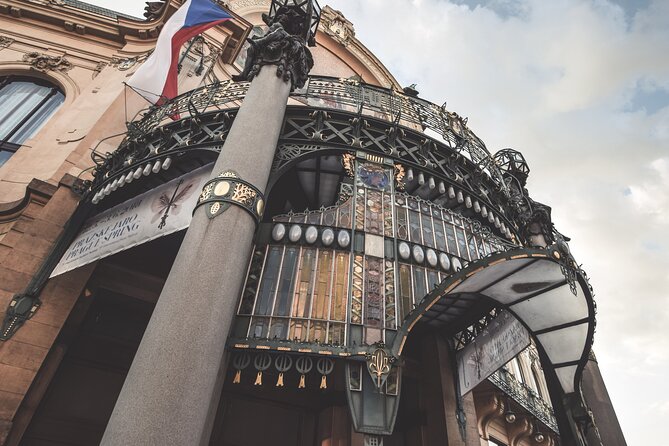
- Obecní Dum and Café Imperial: See how Czech Art Nouveau paired national pride with polished European design, from public halls to a richly decorated café interior.
- Prague Main Train Station: Look up at its grand Art Nouveau dome, one of the route’s strongest reminders that ordinary transport buildings can carry real artistic ambition.
- Lucerna Arcade: Finish among elegant early 20th-century interiors, then consider the playful symbolism of David Černý’s upside-down Wenceslas statue.
- Private three-hour format: Your group alone takes part, with morning and afternoon departures and a historian guide leading the way.
- Walking demands: The route covers several central Prague locations, so comfortable shoes and realistic expectations about walking matter.
Why Prague’s modern face deserves three hours
Most first looks at Prague focus on Gothic churches, Baroque palaces, and the Charles Bridge. Those sights deserve their fame, but they can make the city seem frozen in an earlier age. This tour moves forward to the period when Prague’s architects and artists were testing new shapes, new materials, and new ideas about national identity.
Art Nouveau is easy to recognize once someone points out its visual language. Look for flowing lines, plant forms, ornate lamps, decorative lettering, and façades that treat the whole building as a work of art. The guide may draw your eye to details such as gingko biloba leaves, a reminder that the style also looked beyond Europe for inspiration.
Cubism adds a sharper edge. Instead of soft curves and floral decoration, Cubist design favors geometric forms, broken planes, and angular surfaces. Prague is especially important for this style because it applied Cubist ideas to architecture and everyday objects, not just paintings.
I like the way the route places these styles beside one another. You do not simply hear definitions in a lecture. You see Art Nouveau’s curves, Cubism’s hard angles, and later Art Deco touches within a compact section of central Prague.
The tour also frames the buildings as signs of Czech confidence. Around the turn of the 20th century, Prague was ready to take part in the latest European artistic movements. Architecture became a way to show that the city was modern, ambitious, and culturally self-assured.
More walking tours:
- Prague: 3-Hour Walking Tour of Old Town & Prague Castle
★ 4.7 · 5,696 reviews - Prague: Ghost Walking Tour Where Legends Come To Life
★ 4.4 · 5,253 reviews - Prague: Jewish Quarter Walking Tour with Admission Tickets
★ 4.7 · 3,729 reviews
Starting at the House of the Black Madonna
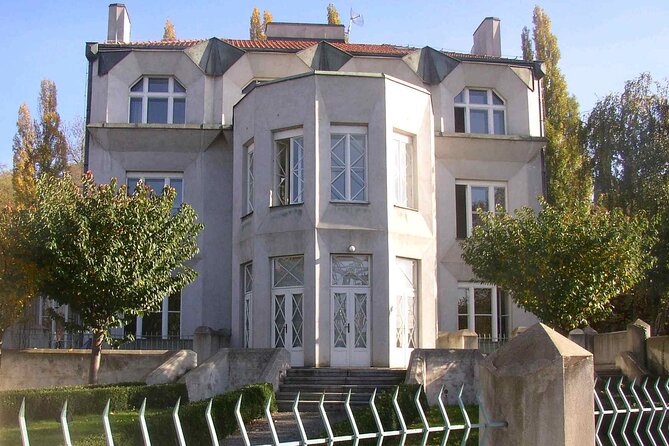
The usual meeting point is Grand Café Orient at Ovocný trh 19 in Prague 1, unless hotel pickup has been arranged. This is a sensible place to begin because the House of the Black Madonna is the first listed stop and the building gives you an immediate lesson in Cubist architecture.
You spend about 10 minutes here. Admission is free, and the value comes from the explanation rather than a long interior visit. The building’s Cubist character is visible in its unusual geometry, which feels startling beside Prague’s older surroundings.
This is a good place to learn how to read the tour’s buildings. Instead of asking only whether you like a façade, look at its angles, repeated shapes, and relationship to the street. The guide can help you see why this building is not simply old Prague with a few modern decorations attached.
The short stop also sets the pace. You will pause often, listen, look upward, and then continue on foot. If you prefer long museum visits, this format may feel quick. If you want a clear introduction to several buildings without spending a full day indoors, it works well.
Obecní Dum turns architecture into national pride
Next comes Obecní Dum, one of Prague’s best-known Art Nouveau buildings. The stop lasts about 15 minutes, again with no admission charge included or required for the listed visit.
Here, the style becomes more ornate and theatrical. Art Nouveau is not shy. Its decoration can appear in lamps, signs, curves, plant shapes, and carefully planned façades. Obecní Dum helps show how the movement could serve a public purpose, not just decorate a private home.
The building also matters in the story of Czech cultural confidence. The route presents it as part of a period when Prague was ready to join current European design trends while expressing its own national character.
You should expect an exterior-focused explanation rather than an extended tour of every room. That is not a flaw, but it is worth knowing. Your guide’s comments help you understand what you are seeing, while the walking schedule keeps the group moving toward the next stop.
K+K Hotel Central and the first Art Nouveau signal
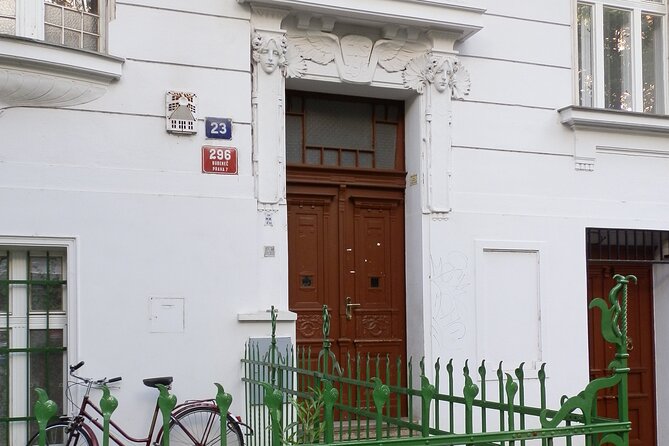
The K+K Hotel Central Prague receives about 10 minutes. It is described as Prague’s first Art Nouveau building, making it a key stop even though the visit is brief.
This is where the tour helps you spot the transition into a new visual age. You may notice decorative details that feel lighter, more flowing, or more organic than the historic styles around them. The guide can explain how those features fit the wider Art Nouveau movement.
The hotel also represents the optimism of the time. New architecture was not merely a matter of taste. It showed that Prague was willing to take part in an international conversation about design, commerce, and urban life.
Because the stop is short, you will want to keep your attention on the façade and the guide’s details. Do not expect a hotel tour or a long interior visit. The strength here is the building’s place in the larger story.
A few more trips of this kind worth comparing:
- Prague Old Town: Private Tour
★ 5.0 · 1,223 reviews - Prague Airport Private Arrival Transfer
★ 4.5 · 991 reviews - Prague Airport Private Departure Transfer
★ 4.5 · 780 reviews - Discover Prague Private Tour – 3 hours
★ 5.0 · 705 reviews
Café Imperial gives the style an interior
The Café Imperial stop lasts only about five minutes, but it adds something important: an interior example. You see how Art Nouveau decoration worked inside a café, not only on a street-facing façade.
This matters because Art Nouveau aimed to shape the full setting. Lighting, surfaces, patterns, and lettering could all contribute to the mood. A café was a social space, so design helped create a sense of modern comfort and refinement.
The limited time means you may only get a quick look and explanation. Still, this pause breaks up the outdoor walking and shows that Prague’s design movement belonged to daily life as much as to monumental buildings.
The Czechoslovak Legion Bank brings Cubism back
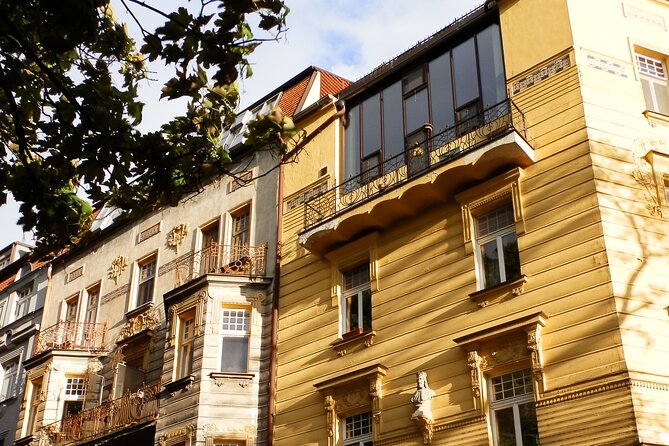
The Czechoslovak Legion Bank receives about 10 minutes. Its architecture and interior are tied to the Czechoslovak Legion of the First World War, giving the stop a stronger political and national context.
This is one of the most useful contrasts on the route. After the flowing decoration of Art Nouveau, Cubist architecture can feel more forceful and disciplined. Angular forms give the building a different mood, and the connection with the Legion adds meaning beyond pure visual style.
You will hear how architecture and national identity could overlap. Buildings did not simply house banks, hotels, or cafés. They also communicated ideas about the country, its people, and its place in Europe.
The stop is another quick one, so you should think of it as a guided reading of the building rather than a full museum visit. The guide’s interpretation is the main attraction.
Prague Main Train Station and its magnificent dome
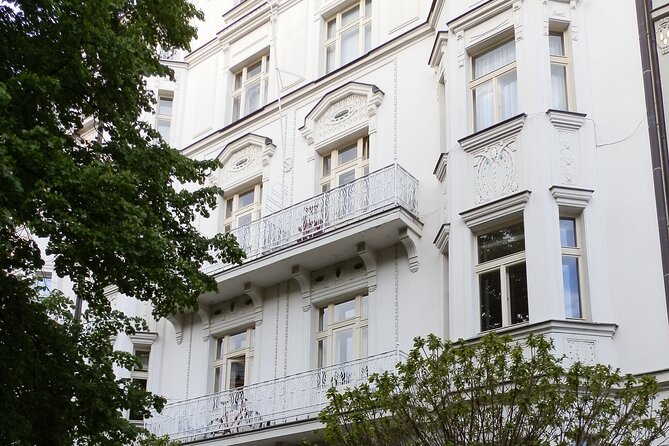
The route then reaches Praha hlavní nádraží, Prague’s main train station. Allow about 15 minutes here, with the emphasis on its Art Nouveau interior dome.
Railway stations are practical buildings, but this one shows how public infrastructure could receive grand artistic treatment. The dome gives the station a sense of occasion. You are not merely passing through a transport hub. You are entering a civic space designed to impress.
I especially like this stop because it broadens the idea of architectural heritage. A station can be as rewarding to study as a palace when someone directs your gaze to the right features.
Practical note: this is an active station, not a quiet monument. You may encounter the usual movement of people and transport activity. Keep close enough to hear the guide and allow a little patience if the setting feels less calm than the earlier streets.
Wenceslas Square links Art Nouveau and Art Deco
The tour spends about 15 minutes around Wenceslas Square, discussing both Art Nouveau and Art Deco architecture. This is a useful midpoint because it shows that styles change rather than arriving in separate, tidy boxes.
Art Nouveau favors flowing decoration and natural forms. Art Deco tends toward stronger geometry, cleaner lines, and a more streamlined appearance. Seeing both in one square helps you compare them in real buildings rather than memorizing textbook descriptions.
The square also gives the tour room to discuss Czech history and the National Revival. Architecture here is connected to public identity, not simply fashion. The guide can explain how a city’s buildings reflect hopes about culture, independence, and modern life.
Because the square is broad and central, this part may feel less intimate than the arcades and cafés. That is a fair trade. You gain a wider view of how architectural styles shape an entire urban setting.
Lucerna Arcade and a surprising final sculpture
Lucerna Arcade is one of the route’s most appealing stops. You spend about 10 minutes viewing the Art Nouveau interior of one of Prague’s most beautiful arcades.
Arcades reward slow looking. Corridors, ceilings, signs, lamps, and shopfronts come together in a designed setting. Even if you have walked past without noticing, a guide can show you how the decorative details create a unified interior.
The final stop is the upside-down statue of King Wenceslas riding a dead horse. The tour uses it to discuss contemporary sculpture, Czech history, and the Czech National Revival. Its humor is immediate, but the symbolism gives the joke more weight.
This ending works because it connects old national imagery with modern Czech commentary. You begin with Cubist architecture and finish with a contemporary work that asks you to think about how national symbols can be questioned, reshaped, or mocked.
It also keeps the tour from ending as a parade of decorative buildings. Prague’s architectural story continues into the present, and this statue gives you a lively final topic.
What the private format is really worth
The price is $396.46 per group of up to 10. For one or two people, that is a significant outlay. For a full group, the per-person cost becomes far more reasonable, especially when you want a private historian rather than a large shared walk.
The private setup gives you several practical advantages. You can ask questions freely, choose a morning or afternoon departure, and avoid being folded into someone else’s schedule. A guide may also adjust explanations to your interests, although the exact level of customization is not specified.
The strongest value comes from interpretation. Most of these buildings can be seen from public streets without paying admission. You are paying for the connections: why the styles look different, how design relates to Czech identity, and what life in Prague may have felt like during this period of change.
The tour is offered in English and includes a historian guide. Food and drinks are not included, so you should plan your own café stop if you want more than the brief Café Imperial visit.
The route takes about three hours. That is long enough to build a coherent story but short enough to fit around other Prague plans. Since it covers many stops, the pace is active rather than leisurely.
Guides, walking pace, and who should book
Robert Wesley has been praised for his enthusiasm, clear explanations, and personal storytelling. His Czech background and Nigerian father gave one tour a particularly personal angle, showing how a guide can connect architecture with lived experience rather than reciting dates.
Bonita has also been praised for combining history, culture, art, and architecture into one well-shaped experience. That mix is important here. A purely technical architecture walk could become dry, while a purely historical tour might skim over the visual details.
You should be comfortable walking for three hours. One direct account describes the route as unsuitable for people with limited mobility, so consider your own needs carefully. The tour is near public transportation, and most people can participate, but the supplied information does not promise step-free access or seating at every stop.
Wear comfortable shoes. You will spend much of the time moving between central Prague buildings, with repeated stops to look at façades and interiors. A morning departure may suit you if you want a fresh start, while an afternoon departure can fit better around a morning castle or Old Town visit.
The walk suits you best if:
- You already plan to see Prague’s famous medieval sights and want a different period.
- You enjoy architecture but want a guide to explain what your eyes are seeing.
- You are traveling with family or friends and can share the private-group price.
- You prefer a focused three-hour experience over a full-day cultural tour.
- You like connecting design with politics, national identity, and daily life.
It may not suit you if you want extended interior access, lots of free time, or a low-cost group excursion.
Booking details worth keeping in mind
Pickup may be offered, but hotel pickup and drop-off are not included unless arranged. Without a pickup arrangement, meet the guide 15 minutes early at Grand Café Orient, Ovocný trh 19, Prague 1.
You receive confirmation when booking. Morning and afternoon departures are available, and you should state your preferred time when making the reservation.
Cancellation is free up to 24 hours before the start time. After that point, the payment is not refunded, and changes made inside the 24-hour window are not accepted. The cutoff follows local Prague time.
Should you book this Prague architecture walk?
I would book it if you want Prague to feel like more than a medieval stage set. The route gives you Art Nouveau curves, Cubist angles, public interiors, national symbolism, and one mischievous modern sculpture in a compact three-hour walk.
The best value comes when several people share the $396.46 group price. Solo visitors and couples should compare that cost with a shared walking tour, but anyone who values private questions and a historian’s full attention may find the extra expense worthwhile.
Book this tour if architecture, Czech identity, and early modern city life interest you. Skip it if your priority is entering major museums or taking a slow café afternoon. For the right audience, it is a sharp, thoughtful way to see Prague’s modern side.
FAQ
How long does the private Prague Art Nouveau and Cubism tour last?
The tour lasts approximately three hours.
How much does the tour cost?
The price is $396.46 per group, with up to 10 people allowed in the private group.
Is the tour private?
Yes. Only your group participates in the activity.
Is the tour offered in English?
Yes. English is the listed language.
Who leads the tour?
A historian guide leads the experience. Robert Wesley and Bonita are named guides associated with particularly praised tours.
Where does the tour start?
Unless hotel pickup has been arranged, meet the guide 15 minutes before the start at Grand Café Orient, Ovocný trh 19, Prague 1.
Is hotel pickup included?
Hotel pickup may be offered if arranged, but hotel pickup and drop-off are not included as standard.
Are food and drinks included?
No. Food and drinks are not included unless specifically stated.
Can I cancel for a full refund?
Yes, if you cancel at least 24 hours before the experience start time. Cancellations or changes made less than 24 hours before the start are not accepted for a refund.
Just added around Prague
- Private Day trip from Prague to Kutná Hora★ 5.0 · 3 reviews
- PRAGUE AIRSOFT SHOOTING GAMES★ 4.7 · 3 reviews
- Private 4-hour City Tour of Prague with driver & official guide w/ Hotel pick up★ 5.0 · 3 reviews
- Glass blowing in Prague★ 4.6 · 3 reviews
- Prague to Karlovy Vary Private Transfer★ 4.5 · 3 reviews
- Disney’s Tarzan Musical★ 5.0 · 3 reviews
- Prague Private Tour★ 5.0 · 3 reviews
- Private Bohemian Glass and Czech Crystal Tour with lunch included★ 5.0 · 3 reviews
Walking Tours, compared.
3-Hour Walking Tour of Old Town & Prague Castle
Read our review →
Ghost Walking Tour Where Legends Come To Life
Read our review →
Jewish Quarter Walking Tour with Admission Tickets
Read our review →
Prague Guided Walking Tour and Cruise with Authentic Czech Lunch
Read our review →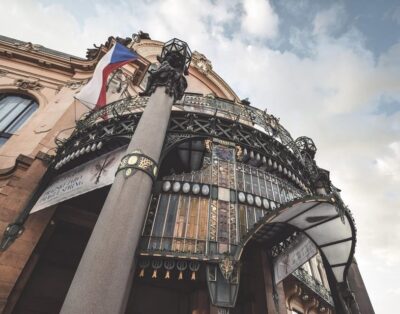
Old Town and Jewish Quarter Guided Walking Tour
Read our review →
Prague Ghost and Legend of Old Town Walking Tour
Read our review →
Prague 3-hour Afternoon Walking Tour including Prague Castle
Read our review →
Ghosts and Legends Nighttime Guided Walking Tour
Read our review →Browse the lists this tour appears in