
REVIEW · WALKING TOURS
Prague: Private Cubism & Art Nouveau Walking Tour
Prague hides its best clues in plain sight. This private walking tour makes the city center more than a parade of famous squares, showing you rare Cubist architecture and the graceful Art Nouveau buildings most people hurry past. I like the personal pace, and I like that a local guide connects buildings to Prague’s rise in wealth between the 1880s and 1914.
The main consideration is the price: $229 for up to two people is a serious fee for a three-hour walk. It makes better value for a couple or two friends who want focused attention, but less sense if you are traveling alone or are happy with a large group tour.
In This Review
- Key details that make this Prague walk different
- Why Prague’s architecture makes this tour worthwhile
- Starting from your hotel in central Prague
- Seeing Cubism where you least expect it
- Art Nouveau around Prague’s major streets
- Connecting buildings to Prague’s rise in wealth
- The Museum of Czech Cubism after the walk
- Following Art Nouveau to the Mucha Museum
- Is $229 good value for two people?
- Who will enjoy this private architecture walk?
- What the feedback tells you about the guiding
- Practical advice before you book
- Should you book this Prague Cubism and Art Nouveau tour?
- FAQ
- How long is the Prague Cubism and Art Nouveau walking tour?
- What is included in the tour?
- How many people can join the private group?
- What languages are available?
- Is the walking tour wheelchair accessible?
- Does the tour include admission to the Museum of Czech Cubism?
- Can I visit the Museum of Alfons Mucha after the tour?
Key details that make this Prague walk different
- Cubism in actual buildings: See one of Europe’s rare examples of Cubist architecture, along with Cubist street details in central Prague.
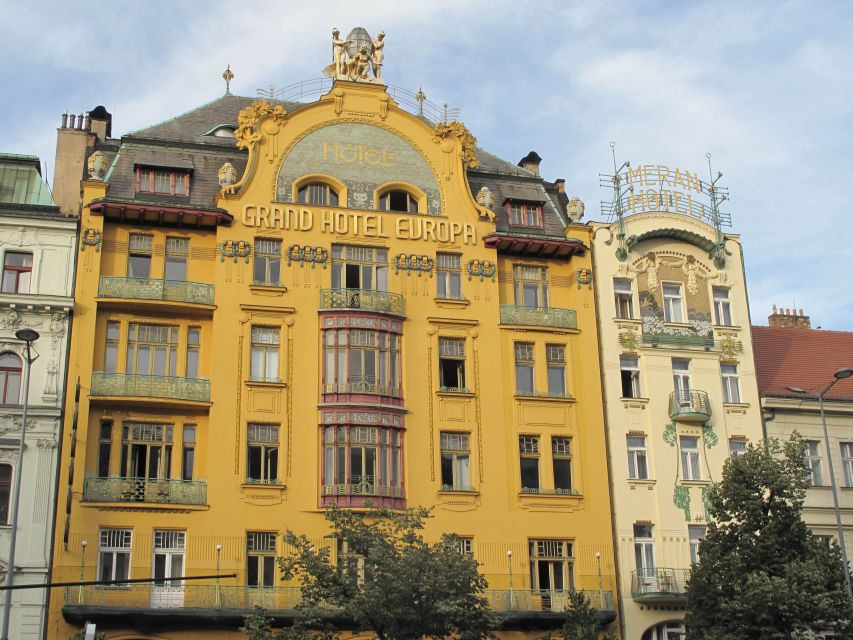
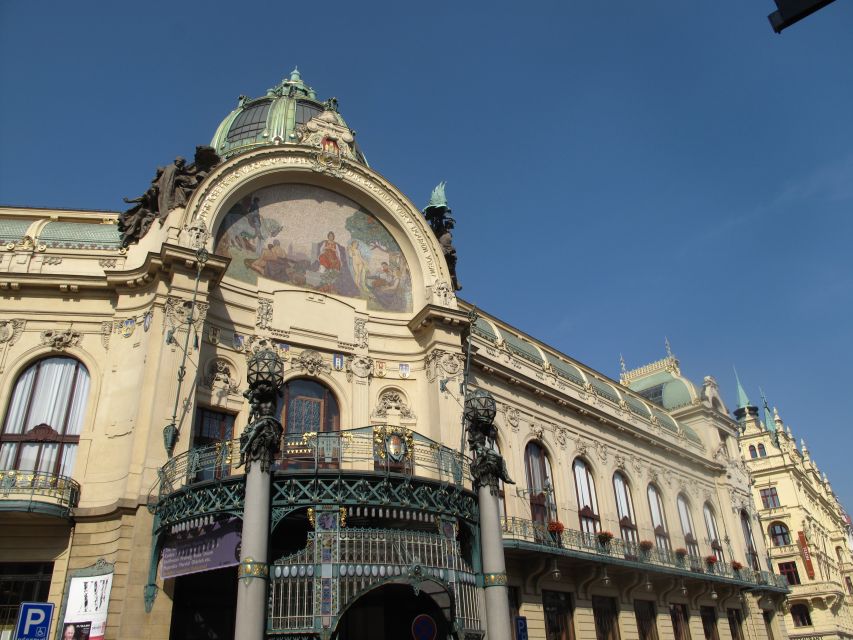
- Art Nouveau in its grandest settings: Pass the Municipal House, Wenceslas Square, National Avenue, Old Town Square, and the Jewish quarter.
- Private attention: The tour is for your group alone, so you can ask questions and set the pace within the three-hour schedule.
- Hotel pickup included: Your guide collects you at your hotel, which removes the need to find a meeting point.
- Four guide languages: Tours are available in English, French, German, and Russian.
- Useful museum follow-up: You can continue at the Museum of Czech Cubism or the Museum of Alfons Mucha after the walk.
Why Prague’s architecture makes this tour worthwhile
Prague is famous for its medieval streets, Baroque churches, and castle views. That older image is so strong that many people miss what happened later, when the city expanded, businesses grew, and wealthy owners rebuilt central buildings in new styles.
The period from the 1880s to 1914 brought a burst of construction and renovation. Banks, companies, and property owners wanted buildings that displayed money, confidence, and modern taste. The result is a city center where Gothic towers, nineteenth-century façades, Cubist experiments, and Art Nouveau decoration can appear within a short walk.
That is the useful angle of this tour. Instead of treating Prague as one giant old town, your guide helps you read its layers. You look at façades, entrances, windows, decorative details, and street elements that can seem like background scenery when you walk alone.
The private format matters here. Architecture tours work best when you can stop and ask why a shape, material, or ornament looks unusual. A guide can point out details at your eye level, then explain the ideas behind them without having to manage a large crowd.
More walking tours:
- Prague: 3-Hour Walking Tour of Old Town & Prague Castle
★ 4.7 · 5,696 reviews - Prague: Ghost Walking Tour Where Legends Come To Life
★ 4.4 · 5,253 reviews - Prague: Jewish Quarter Walking Tour with Admission Tickets
★ 4.7 · 3,729 reviews
Starting from your hotel in central Prague
Pickup from your hotel gives the walk an easy start. You do not need to search for a statue, street corner, or tour office, and that can be helpful after a long arrival day.
The activity lasts three hours, with starting times depending on availability. You should think of it as a focused introduction to central Prague rather than a complete city tour. The subject is architecture, especially Cubism and Art Nouveau, so the guide’s attention will go toward façades and urban details rather than every major landmark in town.
Because this is a private group, the pace can be more comfortable than on a standard group walk. You might spend longer at a building that catches your interest, or move on sooner if a particular stop is not your priority. Still, three hours passes quickly in Prague, so expect a steady walk through the Old Town and New Town areas.
The tour is wheelchair accessible, an important practical point for anyone checking walking activities carefully. The supplied details do not describe the exact route length or surface conditions, so you should confirm any specific mobility needs before booking.
Seeing Cubism where you least expect it
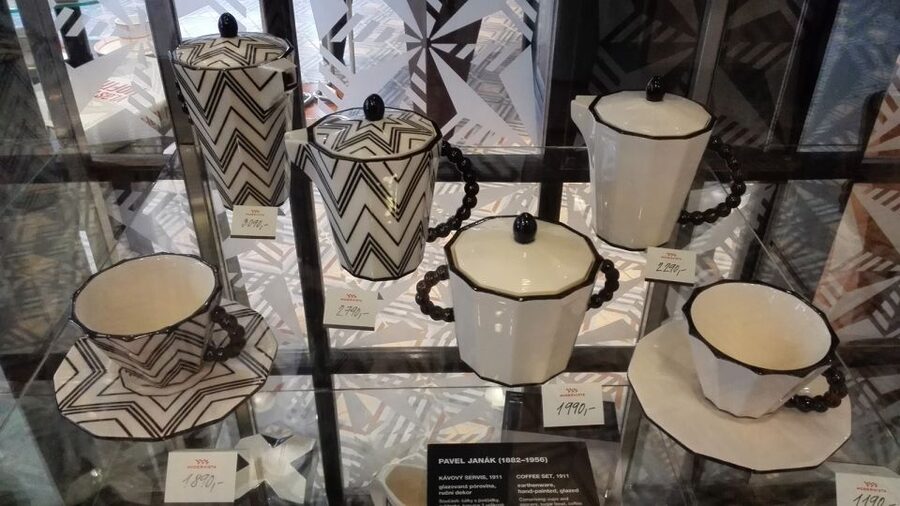
Cubism is usually associated with paintings made of sharp angles and broken forms. In Prague, the style also reached architecture, furniture, interiors, and ordinary urban objects. That makes the city unusual: you are not only looking at a museum piece, but at buildings and street elements still occupying the center.
Your guide shows you examples of Cubist design during the walk. The value is not just seeing an odd-looking façade. You learn to notice the repeated visual language: angular forms, geometric patterns, and a preference for strong, fractured shapes instead of the soft curves common in Art Nouveau.
The tour description presents architectural Cubism as rare outside Prague. That is a good reason to choose this experience if you have already seen the city’s main sights and want a more specialized subject. You can pass a famous square several times without noticing that a nearby building belongs to a style found in very few places.
Cubism also gives the walk a nice surprise factor. Prague’s grandest buildings are easy to find, but Cubist details may require a guide’s eye. The positive comments about discovering hidden beauties fit this part of the experience especially well. You are not being led to a single spectacular monument. You are being trained to spot unusual work among more familiar streets.
One limitation is that people looking for a broad art survey may find the Cubist section too narrow. This is an architecture walk, not a full museum lecture on Czech modernism. If the subject interests you, though, the narrow focus is a strength.
Art Nouveau around Prague’s major streets
Art Nouveau became popular during the same period of rapid growth. Its lines are usually more flowing than Cubism’s, and its decoration can spread across a whole façade. Prague offers many strong examples, and this walk uses central landmarks to show how the style entered public and commercial life.
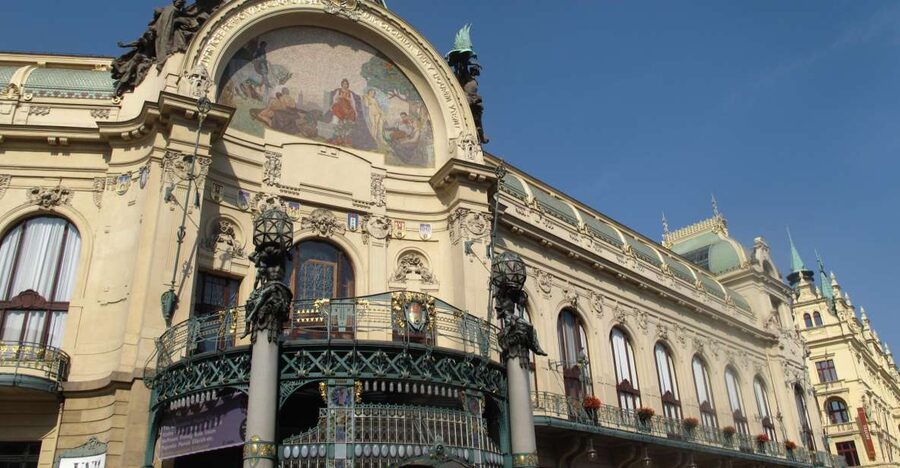
The Municipal House is one of the clearest stops named for the route. Its scale and decorative treatment show how much confidence Prague’s institutions wanted to project in the early twentieth century. You do not need to be an architecture specialist to understand the message: this was design meant to impress.
Wenceslas Square offers another useful setting. The square is not just a place for photographs and shopping. Its surrounding buildings reflect the city’s growth and changing tastes, giving your guide a chance to explain how large urban spaces developed.
National Avenue, Old Town Square, and the Jewish quarter are also included among the areas you may pass. Each adds a different view of central Prague. Old Town Square is packed with famous history, but an architecture guide can shift your attention from the crowds and clock to the façades around you. National Avenue helps show how modern commercial Prague grew beside older streets. The Jewish quarter adds another part of the central city where architecture, rebuilding, and urban change meet.
The itinerary details do not promise entry into every building. You should expect to examine the city from the streets, with explanations from your guide. That is worth knowing if you want interiors, museum collections, or extended time inside the Municipal House. The strength is the outdoor comparison between styles, not a series of indoor admissions.
A few more trips of this kind worth comparing:
- Prague Old Town: Private Tour
★ 5.0 · 1,223 reviews - Prague Airport Private Arrival Transfer
★ 4.5 · 991 reviews - Prague Airport Private Departure Transfer
★ 4.5 · 780 reviews - Discover Prague Private Tour – 3 hours
★ 5.0 · 705 reviews
Connecting buildings to Prague’s rise in wealth
The historical background gives the walk more weight. During the second half of the nineteenth century, Prague was developing and becoming richer. Companies, banks, and private owners rebuilt or enlarged properties to show their new status.
That idea turns architecture into evidence. A façade is not decoration alone. It can show who had money, who wanted public recognition, and how the city saw itself at the time. Your guide uses the buildings of the Old Town and New Town to make that change visible.
This is also where a local guide adds real value. A bare list of addresses would not explain why one building uses curves and flowers while another favors hard angles. The strongest praise for this experience centers on guide competence and the way the walk combines Prague’s past with less obvious sights. That is exactly the service you are paying for.
If you have a general interest in history, design, or city planning, you will probably get more from the explanations than from the sightseeing alone. If you prefer fast photo stops, the commentary may feel slower. The right mindset is to look upward, pause often, and let the city’s newer layers share the stage with its medieval ones.
The Museum of Czech Cubism after the walk
The tour ends with a natural next step: the Museum of Czech Cubism. Admission is not listed as part of the walking tour, so you would visit it separately.
That separation works well. The outdoor walk gives you a visual introduction, and the museum can provide a closer look at the movement’s objects and ideas. You do not need to force a museum visit into the three-hour schedule, and you can decide afterward if you want more.
The museum is especially useful if the architectural examples leave you curious about how Cubism shaped Czech design beyond façades. Since the tour focuses on central streets, the museum offers a way to continue the subject indoors.
You should allow extra time if this follow-up is important to you. The walking tour itself does not include the museum, and its operating hours or admission arrangements are not provided here.
Following Art Nouveau to the Mucha Museum
Art Nouveau fans have a similar follow-up at the Museum of Alfons Mucha. Mucha was a leading Art Nouveau artist, and the museum gives you a chance to connect the city’s buildings with one of the period’s best-known Czech creative figures.
This pairing is useful because the tour shows Art Nouveau as part of the city, while the museum can help you focus on the artist’s work. You get the streets first, then the gallery if you want a closer look at the style’s visual language.
The museum is not included in the tour price. Treat it as an optional extension rather than part of the promised itinerary. If you have only one day in Prague, the walking tour itself may be enough for a first look. If Art Nouveau is your main reason for booking, plan time for both.
Is $229 good value for two people?
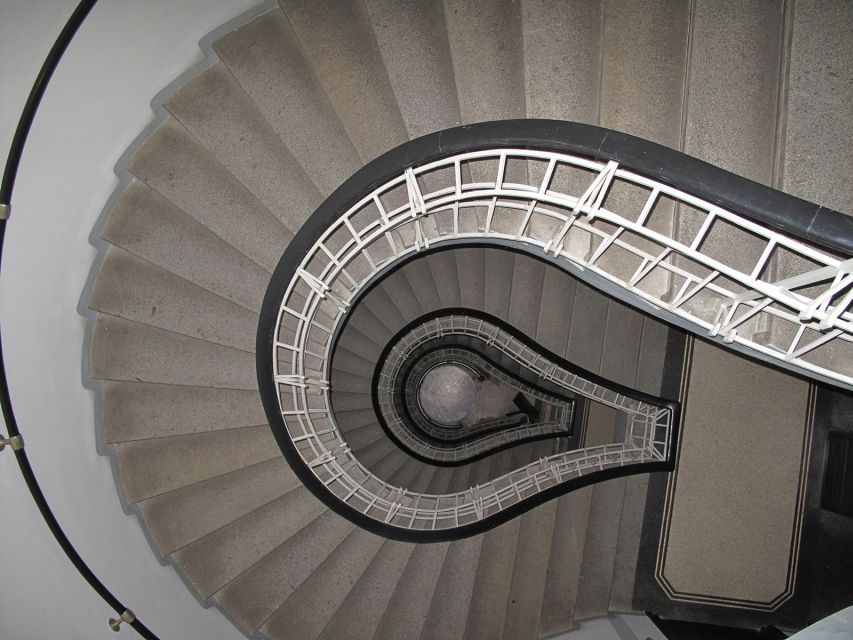
The price is $229 per group of up to two people. That is not a budget walk, but it changes meaning when you divide it between two people: $114.50 each for three hours of private guiding.
For a couple who wants a specialist introduction and hotel pickup, the cost can be reasonable. You are paying for privacy, a guide who can speak directly to your interests, and a route built around details you might otherwise miss. The value improves if you use the tour to orient yourself early in your stay, then visit the Czech Cubism or Mucha museum afterward.
For one person, the price is harder to justify unless architecture is a major priority. A larger group tour would usually spread the guide cost across more people, though this particular experience offers privacy rather than a lower rate.
You should also remember that museum admission is not included in the listed inclusions. The private guide is included, but the extra museums are separate plans and expenses.
Who will enjoy this private architecture walk?
I would recommend this tour most strongly to:
- Couples who want a private activity with a local guide.
- Repeat Prague visitors seeking something beyond the castle, Charles Bridge, and astronomical clock.
- People interested in architecture, design, photography, or urban history.
- First-time visitors who want to understand central Prague before exploring alone.
- Anyone who prefers asking questions rather than following a fixed group.
It may be less suitable for someone who wants a general sightseeing route covering every famous landmark. It also may not be the best fit if you dislike walking or have no interest in buildings and decorative details.
The available languages are English, French, German, and Russian. That gives you a useful choice when arranging a private tour, especially if one of those languages helps you follow design terms and historical explanations more easily.
What the feedback tells you about the guiding
The strongest pattern in the feedback is praise for the guides. One June 2025 booking from Austria described a very capable female guide and highlighted both less obvious Prague sights and the city’s history. Other comments call the guide highly competent, say the time was fantastic, and recommend the experience directly.
A German booking from October 2022 praised the exciting architecture discovered during the walk. That is a good signal for the tour’s central promise: you should expect the buildings themselves to be the main event, not filler between better-known attractions.
The overall rating is 5 out of 5 from 15 reviews. That is a small sample, so I would not treat it as proof that every guide or route will match your ideal. It does support the idea that the experience consistently delivers strong personal guiding and unusual architectural discoveries.
The available information does not provide the names of individual guides. You should therefore book based on the private format, subject, language, and pickup rather than expecting a particular guide by name.
Practical advice before you book
Wear comfortable shoes and leave room for pauses. The tour is three hours on foot, and the details matter more when you are not rushing from one landmark to another.
Try to schedule it early in your Prague stay if you like using tours to get oriented. Afterward, you may recognize Cubist and Art Nouveau details on streets you revisit alone.
Ask your guide to point out the most important Cubist street elements and to separate genuine architectural Cubism from ordinary geometric decoration. That question can make the visual differences easier to understand.
If you want both museum follow-ups, check their schedules before setting your tour time. The walk points you toward the Museum of Czech Cubism and the Museum of Alfons Mucha, but neither is included.
The booking terms are flexible: you can cancel up to 24 hours before the activity for a full refund, and you can reserve now and pay later. That is useful when your Prague schedule is still shifting.
Should you book this Prague Cubism and Art Nouveau tour?
Book it if you want Prague explained through buildings rather than simply photographed. The private setting, hotel pickup, rare Cubist architecture, and strong praise for guide quality give the experience a clear purpose.
I would skip it if you want the cheapest possible introduction or a broad tour of every major sight. At $229 for two people, it earns its price only when personal attention and specialist architecture matter to you.
For the right pair, this is a smart three-hour addition to Prague. You leave with more than a list of landmarks. You learn where to look, what the angles and ornaments mean, and why a city famous for old stonework also became a testing ground for modern design.
FAQ
How long is the Prague Cubism and Art Nouveau walking tour?
The tour lasts three hours.
What is included in the tour?
A private guide and pickup from your hotel are included.
How many people can join the private group?
The price is for a private group of up to two people.
What languages are available?
The tour is available in English, French, German, and Russian.
Is the walking tour wheelchair accessible?
Yes, the activity is listed as wheelchair accessible.
Does the tour include admission to the Museum of Czech Cubism?
No admission is listed as included. You can visit the Museum of Czech Cubism separately after the walk.
Can I visit the Museum of Alfons Mucha after the tour?
Yes. The tour suggests the Museum of Alfons Mucha as a follow-up visit, but museum admission is not included in the tour details.
Just added around Prague
- Private Day trip from Prague to Kutná Hora★ 5.0 · 3 reviews
- PRAGUE AIRSOFT SHOOTING GAMES★ 4.7 · 3 reviews
- Private 4-hour City Tour of Prague with driver & official guide w/ Hotel pick up★ 5.0 · 3 reviews
- Glass blowing in Prague★ 4.6 · 3 reviews
- Prague to Karlovy Vary Private Transfer★ 4.5 · 3 reviews
- Disney’s Tarzan Musical★ 5.0 · 3 reviews
- Prague Private Tour★ 5.0 · 3 reviews
- Private Bohemian Glass and Czech Crystal Tour with lunch included★ 5.0 · 3 reviews
Walking Tours, compared.
3-Hour Walking Tour of Old Town & Prague Castle
Read our review →
Ghost Walking Tour Where Legends Come To Life
Read our review →
Jewish Quarter Walking Tour with Admission Tickets
Read our review →
Prague Guided Walking Tour and Cruise with Authentic Czech Lunch
Read our review →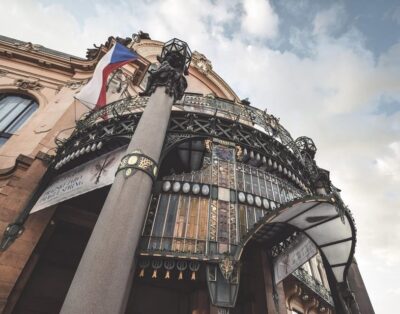
Old Town and Jewish Quarter Guided Walking Tour
Read our review →
Prague Ghost and Legend of Old Town Walking Tour
Read our review →
Prague 3-hour Afternoon Walking Tour including Prague Castle
Read our review →
Ghosts and Legends Nighttime Guided Walking Tour
Read our review →Browse the lists this tour appears in