
REVIEW · WALKING TOURS
Prague Art Nouveau and Cubism Walking Tour
Prague has more than Gothic spires. This three-hour walk reveals the city’s daring Art Nouveau curves and sharp Cubist forms, with a historian guide explaining how design, politics, and Czech identity shaped the streets. I especially like the small group of no more than eight and the chance to see interiors that are easy to miss, including the Lucerna arcade and Café Imperial. The main drawback is the price, $126.71 per person, which feels high for a walking tour unless architecture and history are central to your trip.
I also like how the route links buildings to practical inventions, national revival, and the upheavals of war. Guides such as Vadim, Vadim, Betty, Bonita, Matous, and Vitam have been praised for adjusting the pace, answering questions, and pointing out places to eat afterward. You should allow for steady walking, changing weather, and a few brief exterior stops where the real reward comes from careful looking rather than admission-ticket attractions.
In This Review
- Key details that shape the experience
- Why this walk changes the way you see Prague
- Starting at Ovocný trh and the House of the Black Madonna
- Obecní dům and the first Art Nouveau lesson
- K+K Hotel Central and Café Imperial
- Czech Legion Bank and the hard angles of Cubism
- Prague Main Train Station and practical modernity
- Wenceslas Square and the city’s changing identity
- Lucerna Music Bar and a lively final contrast
- King Wenceslas on a dead horse
- Ending at Café Louvre
- The guide makes or breaks the value
- Is $126.71 a fair price?
- Who should book this Prague architecture walk?
- Should you book it?
- FAQ
- How long is the Prague Art Nouveau and Cubism Walking Tour?
- What language is the tour offered in?
- How large is the group?
- Where does the tour begin?
- Where does the tour end?
- What time does the tour start?
- Are food and drinks included?
- What attractions are visited?
Key details that shape the experience
- A maximum of eight people: The small format allows questions, slower looks at façades, and occasional tailoring around your interests.
- Two design movements in one walk: You compare Art Nouveau’s flowing lines with Cubism’s crystal-like angles and pyramids.
- Prague’s modern side: The route includes the House of the Black Madonna, Czech Legion Bank, Lucerna, and an unusual sculpture of King Wenceslas on a dead horse.
- Architecture tied to daily life: You hear about central heating, ventilation, drinking water, hydraulic elevators, steam laundry, and intercoms.
- A historian’s view of the city: The tour connects buildings with Czech national identity, economic change, politics, and European wars.
- A useful finish: The walk ends at Café Louvre, close to restaurants and central Prague sights.
Why this walk changes the way you see Prague
Many first-time visits to Prague focus on medieval towers, Baroque churches, and the Charles Bridge. This tour gives you a different city: confident, urban, inventive, and eager to join the modern world around the turn of the twentieth century.
I like that the guide does not treat Art Nouveau as a collection of pretty flowers. You learn to notice gingko leaves, curved lettering, decorative lamps, flowing metalwork, and the influence of Eastern art and design. Those details turn ordinary streets into something you can read.
Cubism brings a sharper contrast. Prague became one of Europe’s key centers for Cubist art, and its architecture can look almost crystalline. Instead of soft curves, you see faceted surfaces, triangular patterns, pyramidal shapes, and interiors designed to feel like three-dimensional compositions.
The best part is the link between style and society. A new façade could signal modern taste, but a new building also required new systems behind the walls. Central heating, ventilation, running drinking water, hydraulic lifts, steam-powered laundry, and intercoms all point to a city thinking about comfort and technology in a new way.
That approach suits you if you like to understand why a place looks the way it does. It also works if you are not an architecture specialist. Several guides have been praised for explaining Art Nouveau, Art Deco, and Cubism in clear terms, without turning the walk into a lecture.
More walking tours:
- Prague: 3-Hour Walking Tour of Old Town & Prague Castle
★ 4.7 · 5,696 reviews - Prague: Ghost Walking Tour Where Legends Come To Life
★ 4.4 · 5,253 reviews - Prague: Jewish Quarter Walking Tour with Admission Tickets
★ 4.7 · 3,729 reviews
Starting at Ovocný trh and the House of the Black Madonna
The meeting point is Ovocný trh 19 in Prague’s Old Town. The route begins with the House of the Black Madonna, a compact but important Cubist building that gives you an immediate lesson in Prague’s unusual design language.
The building’s name comes from the black Madonna statue on its exterior. Its Cubist form is not merely a decorative shell. The angles, geometric surfaces, and bold composition show how Czech architects adapted a major European art movement for the street.
You have about ten minutes here, with no admission fee listed. That means the focus is on the exterior and the guide’s explanation rather than an extended museum visit. If you are hoping to spend a long time inside, keep your expectations in check.
Still, this is an excellent opening stop. You begin with a building that looks unlike the Gothic and Baroque landmarks nearby. The contrast makes the point quickly: Prague’s architectural story did not end in the Middle Ages.
Obecní dům and the first Art Nouveau lesson
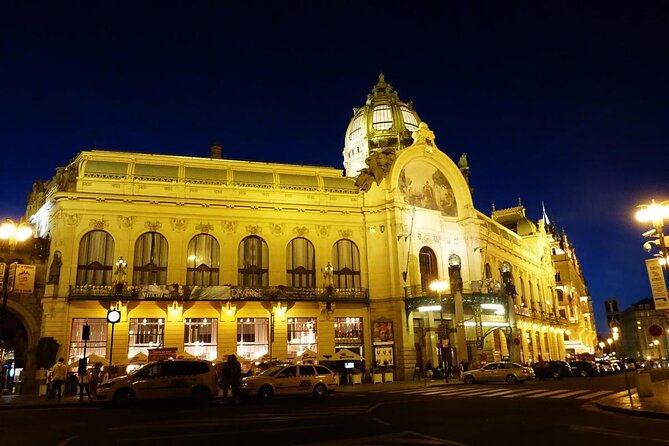
The next stop is Obecní dům, one of Prague’s great Art Nouveau landmarks. You get about fifteen minutes to examine the building and hear how its decorative program reflects Czech cultural confidence.
Look for plant forms, flowing ornament, expressive lettering, and elaborate details around the entrances and windows. This is the kind of place where a guide adds real value because the façade can overwhelm you. A practiced eye helps separate the structure from the decoration.
The building also helps explain the Czech National Revival, a period when language, culture, and national identity mattered intensely. Architecture became part of that effort. A public building could express pride in Czech artistic talent while presenting Prague as a modern European capital.
No entrance ticket is included, and the listed stop is brief. You should think of Obecní dům as a close architectural viewing rather than a full interior tour. If you want to return later for a longer look, the walk gives you a useful reason to do so.
K+K Hotel Central and Café Imperial
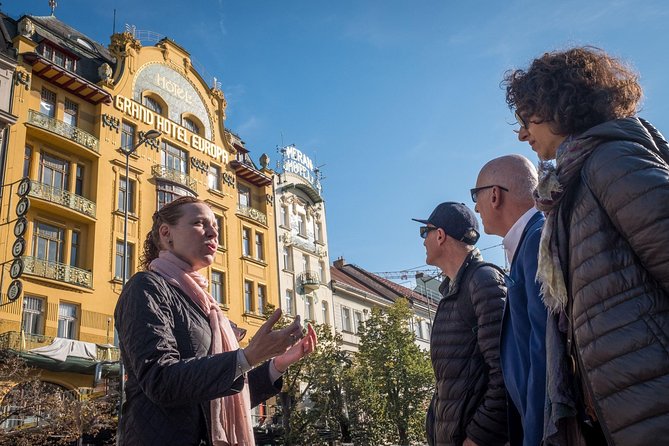
K+K Hotel Central is described as Prague’s first Art Nouveau building. The ten-minute stop gives you a chance to see how the movement entered the city’s commercial and hotel architecture.
This is a useful reminder that Art Nouveau was not limited to grand civic buildings. Hotels, cafés, banks, and apartment blocks all used the new style. You might find yourself looking at façades you would otherwise pass without a second thought.
Café Imperial follows, with about five minutes devoted to its distinctive Art Nouveau interior. The short timing matters. You may view the interior, but you should not expect a long café break or a meal during the tour.
Food and drinks are not included. If you want to sit down at one of the cafés along the route, save that for after the walk. Several guides have also suggested restaurants at the end, which makes it easy to turn the architecture lesson into a meal in a historic setting.
A completely different kind of day out in Prague:
- Prague: 50-Minute Sightseeing Evening Cruise
★ 4.2 · 33,780 reviews - Prague: Medieval Dinner with Unlimited Drinks
★ 4.4 · 19,847 reviews - Prague: Castle Tour with Local Guide and Entry Ticket
★ 4.6 · 10,422 reviews - Prague Castle 2.5-Hour Tour Including Admission Ticket
★ 4.7 · 8,927 reviews
Czech Legion Bank and the hard angles of Cubism
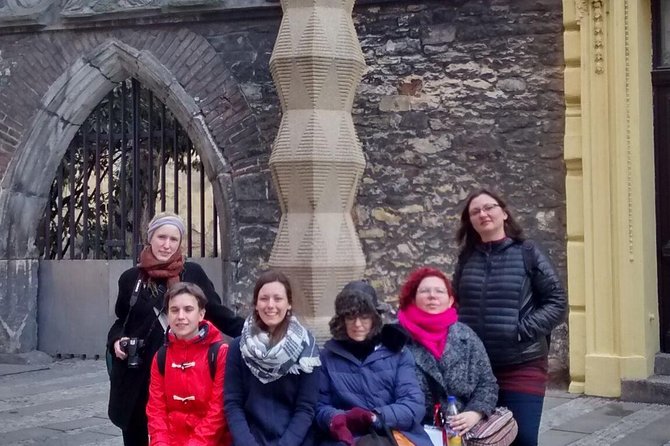
The Czechoslovak Legion Bank offers another strong Cubist contrast. Its design and interior are connected to the Czechoslovak Legion of the First World War, so the stop brings together architecture, military memory, and national identity.
This is where the route becomes more than a style survey. The building helps show how architecture can carry political meaning. Cubism was not only about unusual shapes. In Prague, it became part of a larger cultural search for a distinct Czech modern identity.
You have roughly ten minutes here. The guide’s role is especially useful because Cubism can be difficult to recognize at first. Once you learn to look for fractured planes and crystal-like geometry, the city begins to offer more examples.
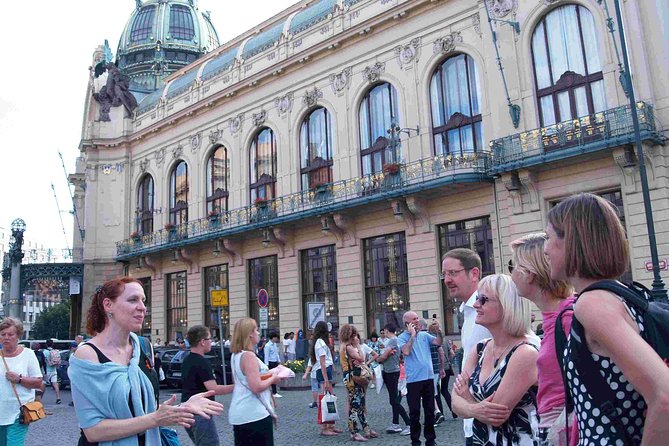
The small group helps at stops like this. A large crowd would make it harder to gather around a façade or ask a question about a detail. With no more than eight people, the guide can adjust the explanation to your interests, at least when timing and the group allow.
Prague Main Train Station and practical modernity
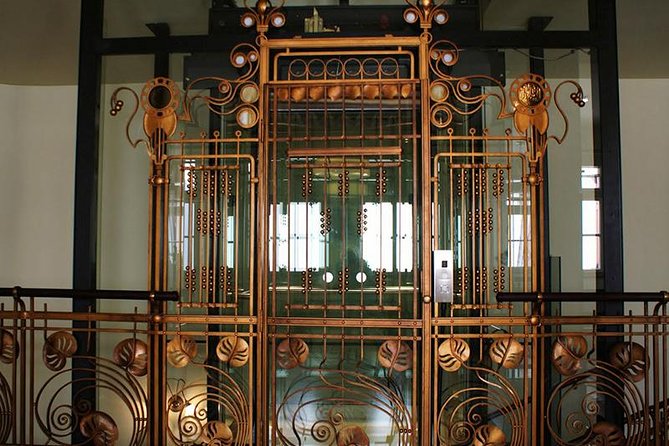
Praha hlavní nádraží, Prague’s main train station, adds scale and drama to the route. The station includes a magnificent Art Nouveau dome, and its function makes the technology discussion feel concrete.
Train stations were symbols of speed, connection, and modern urban life. Here, design met engineering. The ornate interior was not separate from progress. It helped present progress in an attractive, confident form.
The stop lasts about ten minutes. One particularly useful detail from the guides is help with navigating the main station. That may sound like a small bonus, but major rail stations can be confusing, especially when you are carrying luggage or planning a later train trip.
This stop also gives the walk a practical edge. You are not only learning what a building means. You are learning how to understand and use a real part of Prague.
Wenceslas Square and the city’s changing identity
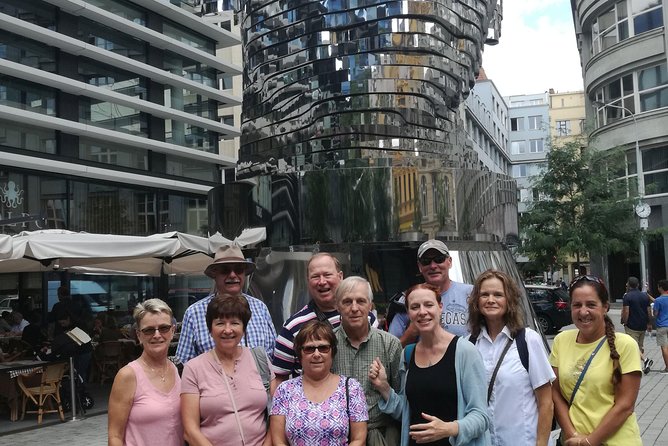
Wenceslas Square receives about fifteen minutes, enough time to discuss its Art Nouveau and Art Deco buildings and the square’s role in Czech public life.
The square is a good place to compare the softer curves of Art Nouveau with the more restrained, geometric style of Art Deco. The shift reflects changing taste, but it also reflects a changing era. The optimism and confidence of the early twentieth century did not last untouched.
The guide places these buildings within the effects of fierce European wars and the political changes that followed. That context is one of the strongest parts of the experience. You see that architectural styles do not develop in a vacuum. They respond to money, technology, national ambition, and events that can overturn a society.
If you prefer a tour that stays strictly visual, this section may feel more historical than architectural. I think that is a strength, but it is worth knowing in advance. The walk asks you to connect façades with the people and forces behind them.
Lucerna Music Bar and a lively final contrast
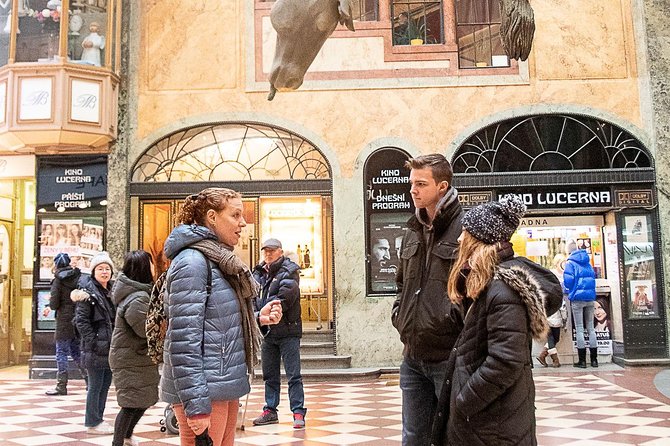
Lucerna Music Bar is one of the route’s most appealing stops. The Art Nouveau interior belongs to one of Prague’s most beautiful arcades, and it offers a glimpse of the era’s optimism and avant-garde spirit.
Arcades are especially useful on an architecture walk because you can see how design shaped public movement. Decorative interiors encouraged people to linger, meet, shop, and take part in city life. The building was not simply something to look at from the pavement.
The ten-minute stop also connects the period’s design to entertainment and modern culture. Prague was not only building banks and railway stations. It was creating spaces for music, social life, and new ideas.
You may want to return later. The tour does not include food or drinks, and a brief viewing is not the same as spending time inside a historic venue. That said, the stop gives you enough information to decide which places deserve a second visit.
King Wenceslas on a dead horse
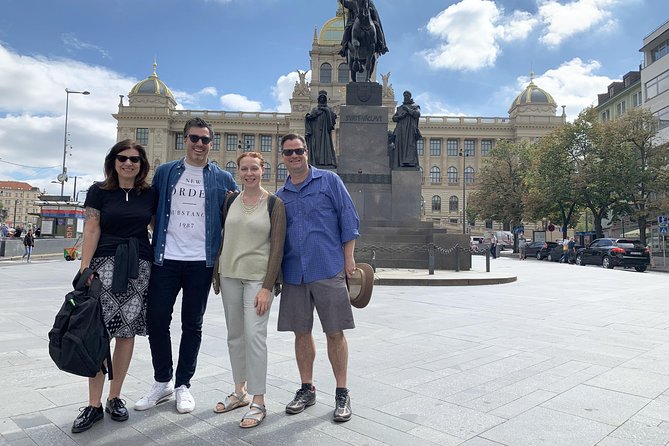
The final listed sight is David Černý’s upside-down statue of King Wenceslas riding a dead horse. It is a sharp modern counterpoint to the historic buildings earlier in the walk.
The guide explains the sculpture’s symbolism in relation to Czech history and the Czech National Revival. Its humor can seem odd at first, but that is part of the point. Prague’s public art often plays with national symbols rather than treating them as untouchable.
This stop broadens the tour beyond Art Nouveau and Cubism. You finish by seeing how later artists question the same stories that earlier architects helped construct. The route therefore becomes a conversation about Prague’s identity, not just a checklist of old buildings.
Ending at Café Louvre
The tour finishes at Café Louvre on Národní 22. The café opened in 1902 and is associated with figures including Franz Kafka, Albert Einstein, and T. G. Masaryk.
That makes the ending feel well chosen. You can continue the period atmosphere over coffee, or use the central location to reach nearby restaurants and attractions. The guide may also suggest places to eat, as some guides have done for past groups.
The listed route lasts about three hours. The schedule includes many brief stops, so expect a steady walk with frequent pauses rather than long indoor visits. Wear comfortable shoes and bring protection from rain or sun. A rainy day does not necessarily ruin the experience, but weather will affect how easily you can study façades and move between stops.
The guide makes or breaks the value
The strongest praise has focused on the guides’ ability to combine architecture with history, politics, economics, and Czech society. Vadim and Vadim have been praised for their depth, humor, patience, and willingness to answer questions. Betty, Bonita, Matous, and Vitam have also been singled out for passion, clear explanations, and personal attention.
You should not assume every guide will give the exact same route or emphasis. The experience can be adjusted around interests and walking ability. One private group even covered sights farther apart and used a tram, though that should not be treated as a standard part of every departure.
The small group is important here. It creates room for conversation, and it makes it easier to ask why a building matters or how to identify a style. If you have a specific interest in Cubism, Art Deco, interiors, politics, or Czech national identity, mention it early.
Is $126.71 a fair price?
At $126.71 per person, this is not a budget stroll. You are paying for a specialist historian guide, a small group, and a carefully connected explanation of Prague’s architecture rather than simple sightseeing commentary.
The value improves if you use the walk as a foundation for the rest of your stay. One guide has helped participants return to buildings with restaurants, and another has made the main train station easier to navigate. You also leave with tools for recognizing styles on your own.
The price is harder to justify if you only want exterior photographs or a fast introduction to famous landmarks. Most stops are free, and several last only five to fifteen minutes. For a family or larger party, ask about group discounts before booking.
Who should book this Prague architecture walk?
I would choose this tour early in a Prague visit if you care about buildings, design, or local history. The knowledge can sharpen later walks through the city, even when you are exploring without a guide.
It is also a good match for mixed-age groups. The experience has worked for a family ranging from 19 to 76 because the storytelling connects visual details to bigger events and ideas.
You may want something else if you dislike walking, want long indoor visits, or prefer a tour centered on Prague Castle and medieval sights. This route is about the city’s modern turn, with short stops, exterior viewing, and historical explanation.
The tour is offered in English, includes a mobile ticket, and is near public transportation. Confirmation is provided at booking, and most people can participate. Free cancellation is available until 24 hours before the start time, while later cancellations and changes are not accepted.
Should you book it?
Book it if you want Prague to make more sense after you leave the main squares. The combination of Art Nouveau ornament, Cubist geometry, Czech politics, new technology, and modern public art gives you a sharper way to read the city.
I would hesitate only if $126.71 feels too steep for three hours or if you want a relaxed café-and-interior tour. For everyone else, the small group and strong historian-led storytelling make this a serious, useful introduction, especially when scheduled near the beginning of your stay.
FAQ
How long is the Prague Art Nouveau and Cubism Walking Tour?
The tour lasts approximately three hours.
What language is the tour offered in?
The tour is offered in English.
How large is the group?
The tour has a maximum of eight participants.
Where does the tour begin?
The meeting point is Ovocný trh 19, Staré Město, 110 00 Prague 1, Czechia.
Where does the tour end?
The tour ends at Café Louvre, Národní 22, 110 00 Prague 1, Czechia.
What time does the tour start?
The listed start time is 10:00 am. The experience is also offered with a choice of morning or afternoon departure, depending on the selected option.
Are food and drinks included?
No. Food and drinks are not included unless specifically stated.
What attractions are visited?
The route includes the House of the Black Madonna, Obecní dům, K+K Hotel Central Prague, Café Imperial, Czechoslovak Legion Bank, Prague Main Train Station, Wenceslas Square, Lucerna Music Bar, and the upside-down statue of King Wenceslas riding a dead horse.
Just added around Prague
- Private Day trip from Prague to Kutná Hora★ 5.0 · 3 reviews
- PRAGUE AIRSOFT SHOOTING GAMES★ 4.7 · 3 reviews
- Private 4-hour City Tour of Prague with driver & official guide w/ Hotel pick up★ 5.0 · 3 reviews
- Glass blowing in Prague★ 4.6 · 3 reviews
- Prague to Karlovy Vary Private Transfer★ 4.5 · 3 reviews
- Prague Private Tour★ 5.0 · 3 reviews
- Disney’s Tarzan Musical★ 5.0 · 3 reviews
- Private Bohemian Glass and Czech Crystal Tour with lunch included★ 5.0 · 3 reviews
Walking Tours, compared.
3-Hour Walking Tour of Old Town & Prague Castle
Read our review →
Ghost Walking Tour Where Legends Come To Life
Read our review →
Jewish Quarter Walking Tour with Admission Tickets
Read our review →
Prague Guided Walking Tour and Cruise with Authentic Czech Lunch
Read our review →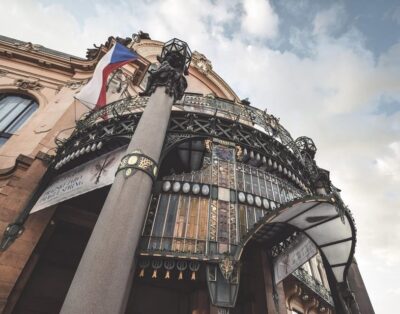
Old Town and Jewish Quarter Guided Walking Tour
Read our review →
Prague Ghost and Legend of Old Town Walking Tour
Read our review →
Prague 3-hour Afternoon Walking Tour including Prague Castle
Read our review →
Ghosts and Legends Nighttime Guided Walking Tour
Read our review →Browse the lists this tour appears in