
REVIEW · WALKING TOURS
Prague Art Nouveau and Cubism Walking Tour
Prague’s façades tell a modern story. This three-hour walk makes the city’s Art Nouveau details easier to read, from ginkgo leaves and curved lines to ornate lamps and café interiors. I like the way it connects architecture with the pre-war social elite who met in hotels, restaurants, and cafés, and I especially like the chance to see interiors at Lucerna and Grand Hotel Europa. The main consideration is pace: the tour keeps moving, so photography stops may feel brief.
I also like that the walk places Art Nouveau beside Prague’s bold Cubist and Rondo-Cubist buildings. Guides such as Robert and Vadim Erent bring strong academic and local backgrounds, while Bonita’s long experience in Prague has helped visitors find places they would probably miss alone. At $123 per person, this is a serious price for three hours, but it can make sense if you want expert interpretation and small-group access, not just a parade of façades.
In This Review
- Key points to know before you book
- Why Prague’s Art Nouveau deserves a walking tour
- Beginning at the House of the Black Madonna
- From older Prague to a modern city
- Reading Art Nouveau façades in practical terms
- Lucerna bar and the world of pre-war cafés
- Grand Hotel Europa and the art of arrival
- Cubism, Rondo-Cubism, and Prague’s national confidence
- Passages, courtyards, and less obvious stops
- The guide makes or breaks this experience
- Pace, weather, and photography
- Is $123 per person a fair price?
- Who should book this Prague architecture walk?
- Should you book the Art Nouveau and Cubism tour?
- FAQ
- How long is the Prague Art Nouveau and Cubism Walking Tour?
- What language is the tour offered in?
- Where does the tour meet?
- Which buildings are included?
- Is this a private or group tour?
- What is the cancellation policy?
Key points to know before you book
- Start at the House of the Black Madonna: Meet downstairs by the front doors of Grand Café Orient on Ovocný 19, Prague 1.
- Look closely at the details: Ginkgo leaves, oriental references, elaborate lamps, decorative façades, and carefully designed interiors are central to the walk.
- Compare several styles: Art Nouveau is explained alongside Cubism, Rondo-Cubism, Gothic buildings, and older Prague landmarks.
- See famous interiors: The route includes the Lucerna bar and elegant Grand Hotel Europa, with possible visits to other interior spaces.
- Expect an academic guide: Guides may be professors, doctoral students, historians, journalists, art critics, or published authors.
- Allow more than three hours if possible: The scheduled walk lasts three hours, but the guide may offer extra time if your plans allow.
Why Prague’s Art Nouveau deserves a walking tour
Prague can overwhelm you with beautiful buildings. A casual walk gives you plenty to admire, but it does not always explain why one façade feels light and floral while another looks geometric, forceful, and almost machine-made.
That is the useful promise of this tour. It teaches you how to recognize Art Nouveau rather than simply point at it. You learn to watch for flowing lines, plant forms, ornamental metalwork, decorative glass, and elaborate lighting. Ginkgo biloba leaves are a particularly good example, since they show how Art Nouveau designers borrowed forms associated with Asia and other parts of the world.
The style arrived near the end of the 19th century and quickly found a home in Prague. The city was changing fast, and its new buildings expressed confidence, technology, leisure, and national ambition. Hotels, cafés, restaurants, and railway stations were especially important because they served people enjoying the new ease of industrial-age travel.
I find that social setting just as interesting as the decoration. These were places where the city’s wealthy and fashionable residents gathered, along with the first international tourists making longer journeys. The tour uses those buildings to explain a vanished pre-war world, one that ended when war disrupted the confident mood of the early 20th century.
More walking tours:
- Prague: 3-Hour Walking Tour of Old Town & Prague Castle
★ 4.7 · 5,696 reviews - Prague: Ghost Walking Tour Where Legends Come To Life
★ 4.4 · 5,253 reviews - Prague: Jewish Quarter Walking Tour with Admission Tickets
★ 4.7 · 3,729 reviews
Beginning at the House of the Black Madonna
The meeting point is the House of the Black Madonna, at the front doors of Grand Café Orient on Ovocný 19. You meet downstairs, on the square, which gives the tour a clear and central starting point.
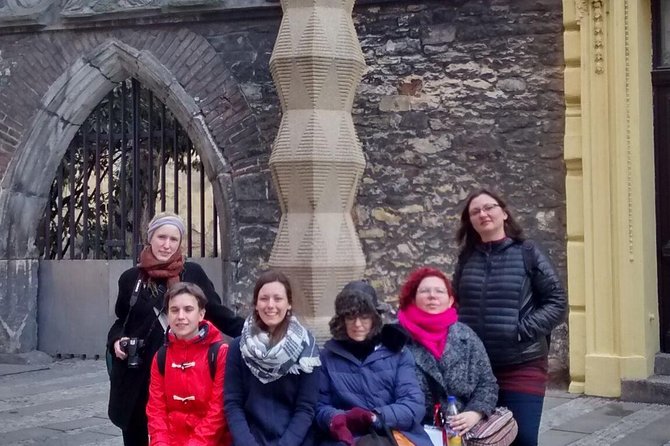
The building is an excellent introduction because it is associated with Czech Cubism, not Art Nouveau. That contrast matters. If the walk began with a simple list of floral façades, the styles could blur together. Starting here gives you an early lesson in how Prague’s architects moved from decorative curves toward sharper shapes and more forceful geometry.
The House of the Black Madonna is also home to Grand Café Orient, an important Cubist interior. The café helps show that Czech Cubism was not limited to paintings or isolated decorative objects. It could shape an entire building and the experience of entering, sitting, and moving through a public room.
You should arrive ready to look up, down, and across. Prague’s architecture often rewards a slow eye, but the guide will help you notice elements you might otherwise pass without understanding. The opening section also gives the group a framework for the rest of the walk, including the way architectural styles changed from earlier Gothic examples through Art Nouveau and into Cubism.
From older Prague to a modern city
One of the strongest features of the tour is its use of architectural sequence. Art Nouveau did not appear in an empty city. It followed centuries of building, religious change, political change, and urban growth.
Robert has been praised for explaining the shift from Gothic architecture through Art Nouveau in a clear, connected way. That approach is more helpful than treating every building as a separate monument. You begin to see Prague as a city that kept adding new ideas on top of older ones.
The guide may also point out Roman remains, frescos, an underground chapel, and older interiors along the route. These details widen the story beyond the advertised styles. They show how much of Prague’s past is tucked behind ordinary street fronts, in courtyards, passages, and buildings that may look less important from outside.
That extra context is one reason the walk can feel different from a standard city sightseeing tour. You are not only learning that a building is Art Nouveau. You are learning why that style appeared when it did, what it said about Prague, and how later Cubist architects reacted against or reshaped earlier decoration.
Reading Art Nouveau façades in practical terms
The tour is at its best when it turns decoration into a visual vocabulary. Instead of hearing a stream of dates, you get clues you can continue using after the walk.
Here are some features you will be encouraged to notice:
- Plant and flower forms: Ginkgo leaves and other organic shapes give façades a flowing, natural quality.
- Curving lines: Art Nouveau often avoids rigid symmetry and uses long, graceful movements in metalwork, plaster, and interior decoration.
- Oriental influences: The ginkgo motif points to the period’s interest in forms from outside Europe.
- Decorative lighting: Elaborate lamps and fixtures are not afterthoughts. They help create the mood of an interior.
- Unified design: In the best examples, doors, railings, windows, furniture, and lamps belong to one visual scheme.
The last point is easy to miss on your own. A building may appear ornate from the street, but the interior reveals how carefully the style was carried through every surface. That is why the planned indoor visits matter. They give you a chance to see Art Nouveau as a complete environment, not just a pretty façade.
A completely different kind of day out in Prague:
- Prague: 50-Minute Sightseeing Evening Cruise
★ 4.2 · 33,780 reviews - Prague: Medieval Dinner with Unlimited Drinks
★ 4.4 · 19,847 reviews - Prague: Castle Tour with Local Guide and Entry Ticket
★ 4.6 · 10,422 reviews - Prague Castle 2.5-Hour Tour Including Admission Ticket
★ 4.7 · 8,927 reviews
Lucerna bar and the world of pre-war cafés
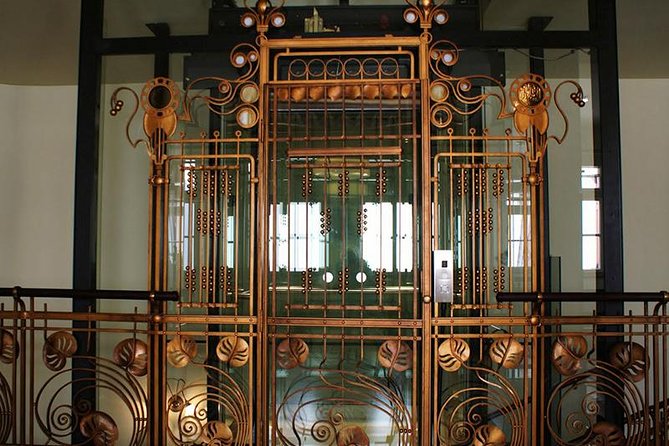
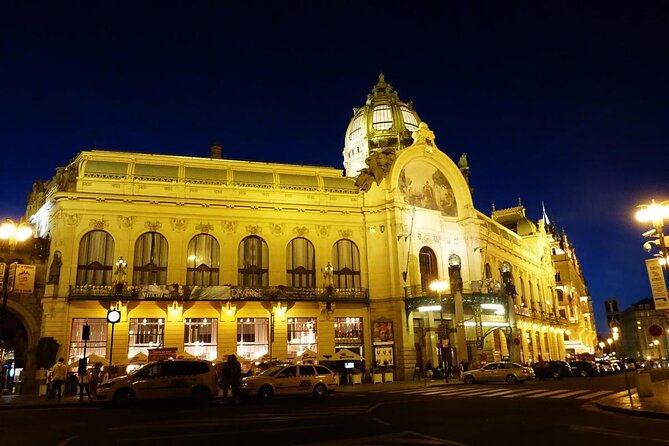
Lucerna is one of the major stops, and its bar offers a useful change from looking at exterior architecture. The interior helps you understand why public entertainment spaces became such important showcases for Art Nouveau.
A bar or restaurant had to make an impression quickly. Guests entered through a decorated doorway, passed under unusual lamps, and sat among surfaces designed to suggest elegance and modernity. These places were social stages as much as businesses.
The tour links such interiors with Prague’s pre-war social elite. The city’s fashionable cafés and restaurants were places for meeting, conversation, business, and display. They also served people who had more money and leisure because industrial growth had made travel and urban entertainment easier.
The practical benefit for you is that the guide gives the room a human setting. You are not just studying a lamp or a decorative panel. You are considering who used the space, what kind of city they believed they were building, and how quickly that world changed.
If you enjoy photography, keep your camera ready but do not expect unlimited time in every interior. One useful detail from the experience is that the group generally keeps moving rather than standing in one place for long periods. That can make the three hours less tiring, but you may need to take photographs quickly or ask for a little extra time.
Grand Hotel Europa and the art of arrival
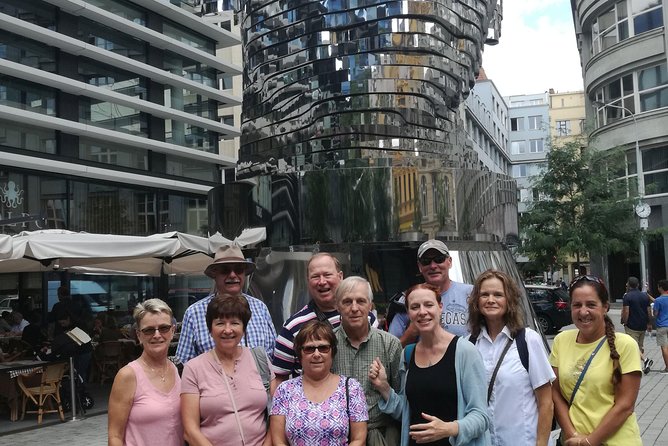
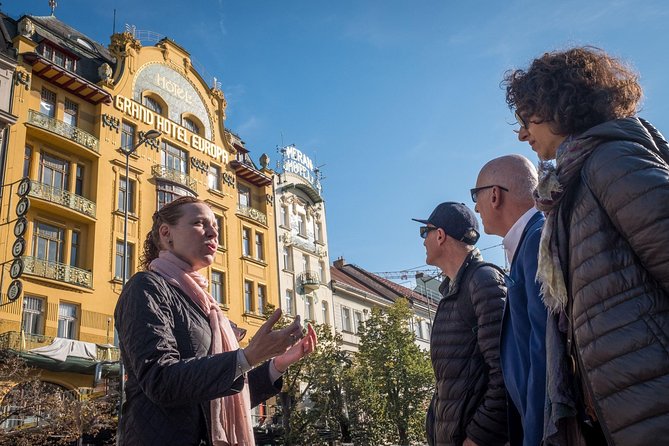
Grand Hotel Europa provides another look at how Art Nouveau shaped hospitality. Hotels were designed for arrival, and their architecture had to signal comfort, status, and modern service before a guest even reached a room.
The building’s elegance makes sense in the context of the first long-distance tourists. A grand hotel was part of the journey itself. It was where people met, ate, exchanged news, and displayed their social position.
This stop also lets you compare the mood of a hotel with the more relaxed setting of a café or bar. You can look for the same attention to ornament, lighting, and coordinated design, but in a setting built around lodging and formal hospitality.
Access to interiors is a major strength of this tour. In cold weather, indoor stops provide welcome warmth, and they give the architecture more depth. You should still understand that interior access can depend on the day and the building, but the route is designed to include places that are easy to miss if you only walk past the main façades.
Cubism, Rondo-Cubism, and Prague’s national confidence
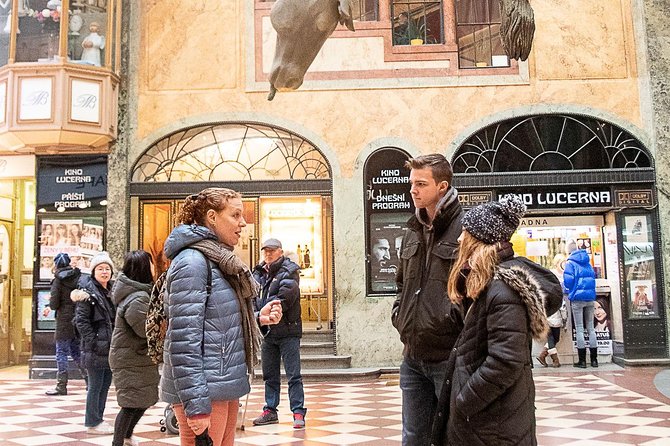
Prague’s Cubism is not simply a side note to Art Nouveau. It is one of the most distinctive parts of the city’s architectural identity.
The House of the Black Madonna offers the clearest starting point, while the Bank of the Legions provides another important comparison. Where Art Nouveau favors plant forms, curves, and decorative movement, Cubism relies more heavily on angles, facets, and geometric tension.
Rondo-Cubism then softens some of those hard edges with rounded forms and circular motifs. Seeing the styles close together helps you understand that Prague’s architects were not following a single straight path. They were testing different ways to express modern life.
The tour also connects these choices with a resurgent Czech national identity. Architecture became a public statement. New buildings could announce that Prague was modern, sophisticated, and capable of creating its own visual language.
Vadim Erent has been praised for making these larger connections without losing sight of individual buildings. His approach links architectural design with social history and the changing sense of what Prague and Czech society could become.
Passages, courtyards, and less obvious stops
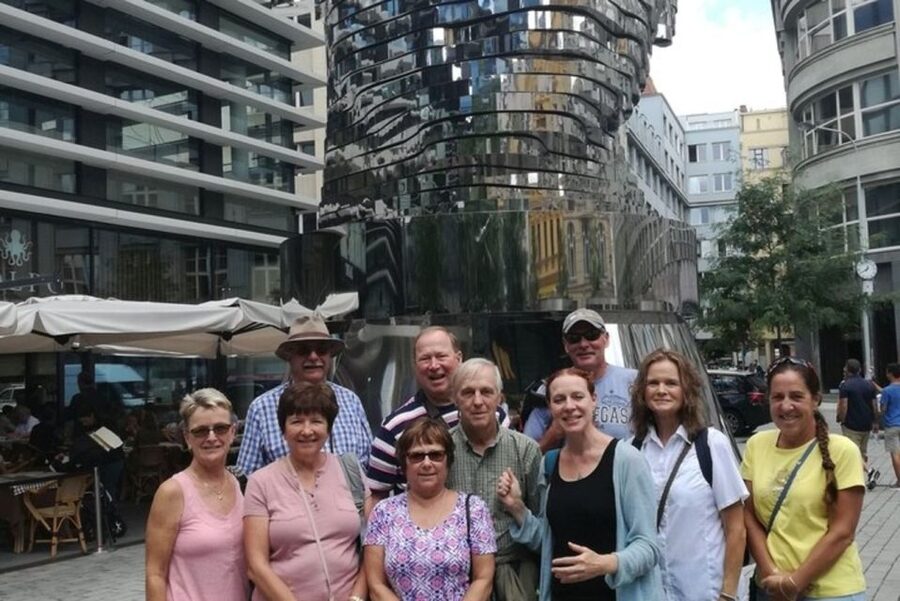
The walk may lead through Prague’s passages and courtyards, where the city’s architecture becomes less formal and more personal. These routes can reveal student cafés, back courtyards, frescos, and small spaces with stories that are easy to miss from the street.
That is where a private or small-group format has real value. You can ask why a passage was built, how it connected different parts of the city, or what a particular interior was used for. The guide can adjust the explanation instead of delivering the same speech to a large crowd.
One route description also includes a university grand hall and an underground chapel among the kinds of places you may encounter. These additions make the walk broader than a strict Art Nouveau checklist. They give you more ways to see how Prague’s public, academic, religious, and commercial buildings relate to one another.
Bonita, who has lived in Prague for many years, has also led visitors to places they would not have found alone. That local familiarity is valuable, especially for repeat visitors who have already seen the major squares and want a more focused look at the city.
The guide makes or breaks this experience
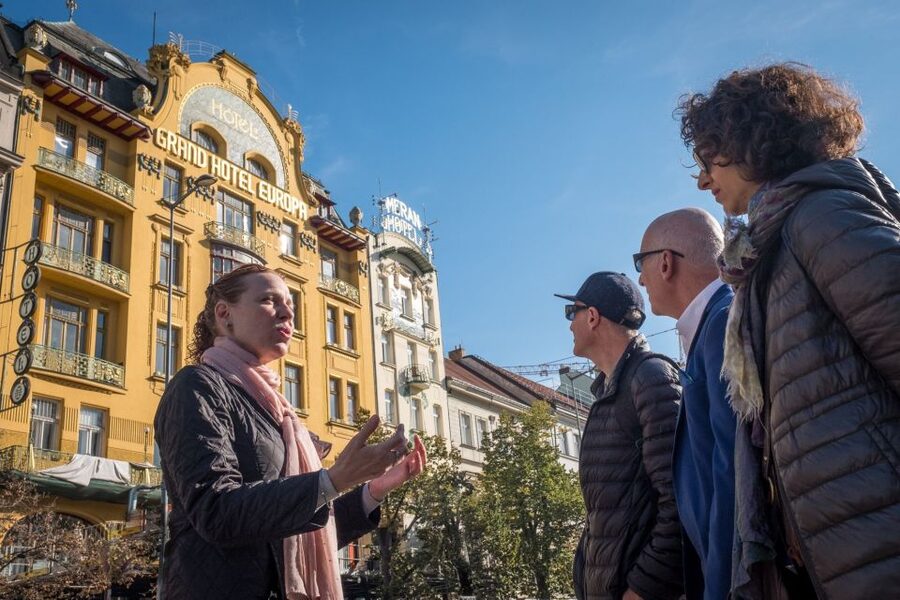
This tour depends heavily on the person leading it. The supplier describes its guides as professors, doctoral students, historians, journalists, art critics, and published authors. The guide names associated with the experience include Robert, Vadim Erent, and Bonita.
Robert’s approach appears especially strong for groups that want a clear architectural timeline. He has been praised for answering questions directly, adding humor, and moving between Gothic, Art Nouveau, and Cubist examples without losing the thread.
Vadim Erent suits people who enjoy ideas as much as buildings. His work connects architectural choices with Prague’s broader social story, and his enthusiasm for Art Nouveau and Cubism gives the walk an animated quality. He also has a reputation for pointing out less obvious places and explaining them in a way that keeps the group interested.
Bonita brings a different strength. Her long residence in Prague and familiarity with the city’s lesser-known interiors can help you see the city beyond the main tourist route.
The common thread is serious preparation delivered in an approachable manner. You should expect substance, but not a dry university lecture. Humor, questions, and movement are part of the experience.
Pace, weather, and photography
Three hours on foot is manageable for many people, but this is not a slow photo walk. The guide keeps the group moving, which prevents long stretches of standing and helps cover a substantial part of central Prague.
That pace has a tradeoff. If you want to photograph every façade, you may wish for longer stops. The best approach is to take quick reference pictures, listen carefully, and ask for a short pause when a particular detail matters to you.
Cold weather does not necessarily ruin the experience because the route can include indoor buildings and cafés. Still, wear comfortable shoes and clothing suited to walking between stops. The supplied details do not state specific accessibility arrangements, so you should ask the operator directly if you have mobility requirements.
The tour is offered in English, with private or small-group formats available. A smaller group should make it easier to hear the guide, ask questions, and spend more time on the details that interest you.
Is $123 per person a fair price?
At $123 per person, this is not a budget walking tour. The fee covers a three-hour guided walk, and no meals or other inclusions are listed.
I would judge the value by the guide rather than by the number of buildings. If you only want to see famous façades and take quick photographs, a less expensive general walking tour may suit you better. You can see many Art Nouveau exteriors without paying for a specialist.
The price makes more sense if you want expert teaching, interior access, and a tailored small-group experience. It is also easier to justify for repeat visitors, architecture students, design lovers, or anyone who wants to understand Prague instead of simply collect photographs.
The academic background of the guides is a meaningful part of the value. You are paying for interpretation, connections, and access to places that can be difficult to find alone. Reserve now and pay later is available, and cancellation is free up to 24 hours in advance, which reduces the risk if your schedule changes.
Who should book this Prague architecture walk?
I would recommend it most strongly to:
- People fascinated by Art Nouveau, Cubism, or decorative arts
- Visitors who want to understand Prague’s architecture in sequence
- Repeat visitors who have already seen the Old Town highlights
- Small groups that prefer questions and discussion
- Photographers who enjoy architectural details
- History-minded visitors interested in the social world before the First World War
It may be less suitable if you want a relaxed route with long café breaks, a general introduction to every major Prague sight, or a tour built mainly around photography. It is also not the best match if you have somewhere fixed to be immediately after the scheduled finish, since the guide may offer to continue when time permits.
Should you book the Art Nouveau and Cubism tour?
Book it if you want Prague’s architecture explained by someone who has spent years studying and interpreting the city. The strongest parts are the connections between styles, the visits to Lucerna and Grand Hotel Europa, and the chance to see passages, courtyards, cafés, and other interiors that are easy to overlook.
I would skip it if $123 feels too high for a three-hour walk or if your main goal is a broad first-time overview of Prague. For a design-focused visit, though, this is a thoughtful choice with unusually strong guide credentials and a personal feel.
FAQ
How long is the Prague Art Nouveau and Cubism Walking Tour?
The guided walking tour lasts three hours. Availability depends on the starting time selected when booking.
What language is the tour offered in?
The tour is offered in English.
Where does the tour meet?
Meet at the House of the Black Madonna, downstairs at the front doors of Grand Café Orient, on the square at Ovocný 19, Prague 1.
Which buildings are included?
The experience includes the Lucerna bar, Grand Hotel Europa, the House of the Black Madonna, and the Bank of the Legions. Other interiors and places may be included along the walk.
Is this a private or group tour?
Private and small-group options are available.
What is the cancellation policy?
You can cancel up to 24 hours in advance for a full refund. Reserve now and pay later is also available.
Just added around Prague
- Private Day trip from Prague to Kutná Hora★ 5.0 · 3 reviews
- PRAGUE AIRSOFT SHOOTING GAMES★ 4.7 · 3 reviews
- Private 4-hour City Tour of Prague with driver & official guide w/ Hotel pick up★ 5.0 · 3 reviews
- Prague to Karlovy Vary Private Transfer★ 4.5 · 3 reviews
- Glass blowing in Prague★ 4.6 · 3 reviews
- Disney’s Tarzan Musical★ 5.0 · 3 reviews
- Prague Private Tour★ 5.0 · 3 reviews
- Private Bohemian Glass and Czech Crystal Tour with lunch included★ 5.0 · 3 reviews
Walking Tours, compared.
3-Hour Walking Tour of Old Town & Prague Castle
Read our review →
Ghost Walking Tour Where Legends Come To Life
Read our review →
Jewish Quarter Walking Tour with Admission Tickets
Read our review →
Prague Guided Walking Tour and Cruise with Authentic Czech Lunch
Read our review →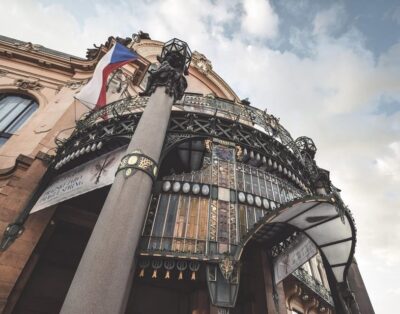
Old Town and Jewish Quarter Guided Walking Tour
Read our review →
Prague Ghost and Legend of Old Town Walking Tour
Read our review →
Prague 3-hour Afternoon Walking Tour including Prague Castle
Read our review →
Ghosts and Legends Nighttime Guided Walking Tour
Read our review →Browse the lists this tour appears in