
REVIEW · PRAGUE
Medieval Prague Through a Nightwatchman’s Eyes
The city changes after sunset. This 90-minute walk through Prague’s Old Town uses a costumed night watchman, a lantern, a halberd, and plenty of grim old tales to make familiar streets feel fresh. I like the small-group limit of 15 and the way guides such as Thomas, David, and Oscar stay in character while still answering modern questions. I also like the quiet riverside pause with a view toward Prague Castle. The main drawback is simple: you walk outdoors in all weather, and the dark, uneven streets may tire anyone with limited mobility.
The tour costs $26.62 per person, which is fair for a focused evening walk with a live guide rather than a simple sightseeing loop. It covers major Old Town landmarks, but its best moments come from the stories about ordinary people, executions, markets, watchmen, and the dangers of medieval Prague. If you already know the main sights well, this adds atmosphere and human detail rather than a long list of dates.
In This Review
- Key points to know before you book
- Starting under the Powder Tower
- Bread and market life at Ovocný trh
- Mozart, Don Giovanni, and the Estates Theatre
- Old Town Square, executions, and the Astronomical Clock
- Jan Hus and the Hussite story
- The Týn Church and Prague’s medieval skyline
- A quiet break beside the Rudolfinum
- Charles Bridge and the nobles across the river
- Why the guides make or break the evening
- Price, timing, and who gets the best value
- Is this the right Prague evening tour for you?
- FAQ
- How long does the Medieval Prague Through a Nightwatchman’s Eyes tour last?
- Where does the tour begin?
- Where does the tour end?
- Is the tour offered in English?
- Does the tour operate in bad weather?
- What is the cancellation policy?
Key points to know before you book
- Start at the Powder Tower: Meet at Náměstí Republiky 5, beside one of Prague’s old defensive gates.
- Travel through several centuries: The guide moves from medieval Prague to the 1600s, then brings in Mozart, Jan Hus, Charles IV, and the city’s old social order.
- Expect a theatrical guide: Thomas, David, and Oscar have been praised for their humor, costumes, props, and strong storytelling.
- A small group helps: The maximum group size is 15, and some departures have only a few people.
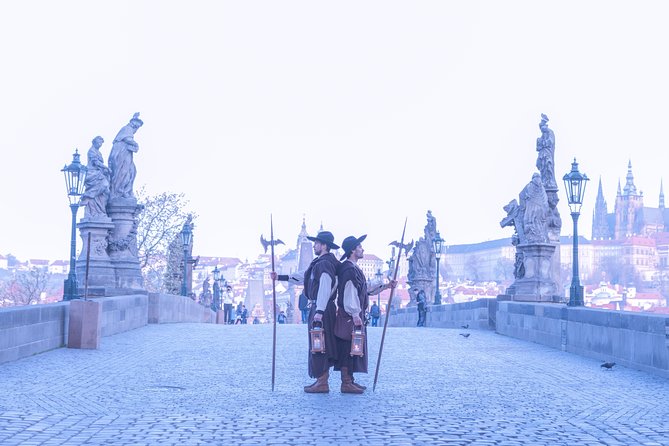
- Finish beside Charles Bridge: The walk ends at the Charles IV statue, a useful spot for continuing into Malá Strana or returning toward Old Town.
- Dress for the forecast: The tour runs in all weather, with no hotel pickup or transport between stops.
Starting under the Powder Tower
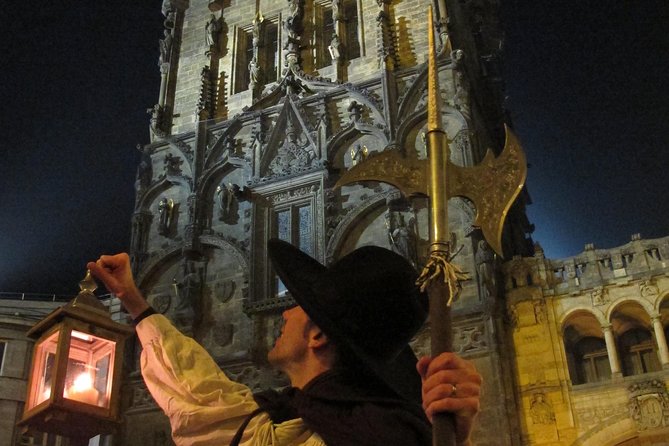
The walk begins at the Powder Tower, at Náměstí Republiky 5. This dark Gothic gate once formed part of the 13 entrances protecting Prague. It was built in the 15th century and later used to store gunpowder, which explains its practical, slightly ominous name.
This is a good starting point because the tower immediately gives the tour a sense of old Prague as a guarded city. You are not beginning with a broad lecture in a modern square. You are meeting beside a former city gate, where a night watchman’s work makes some sense.
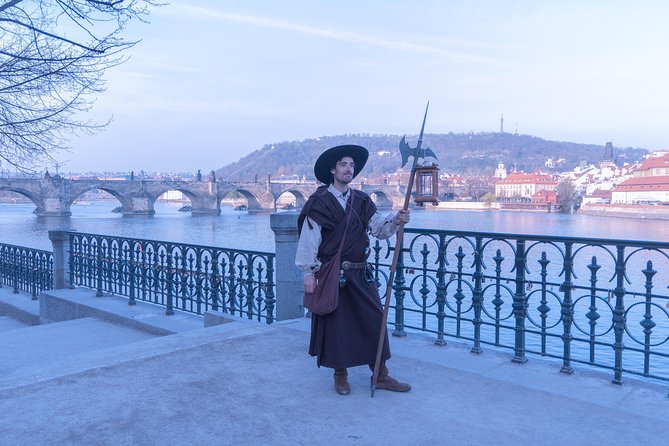
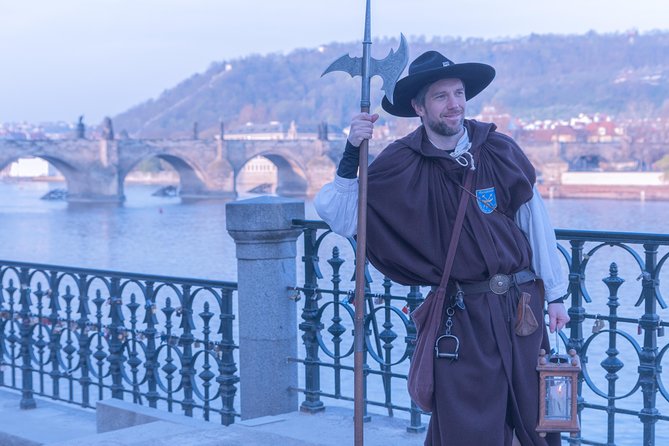
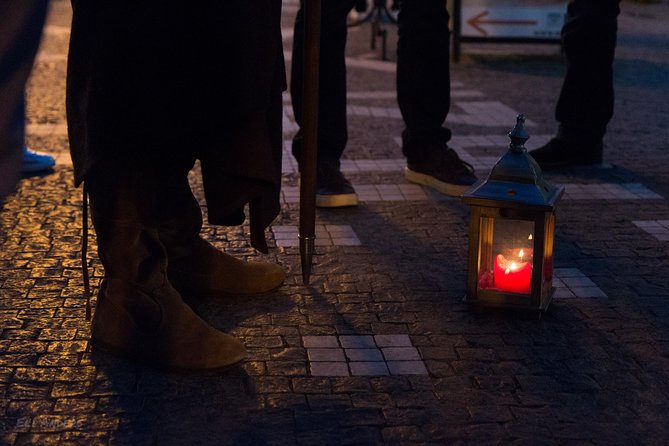
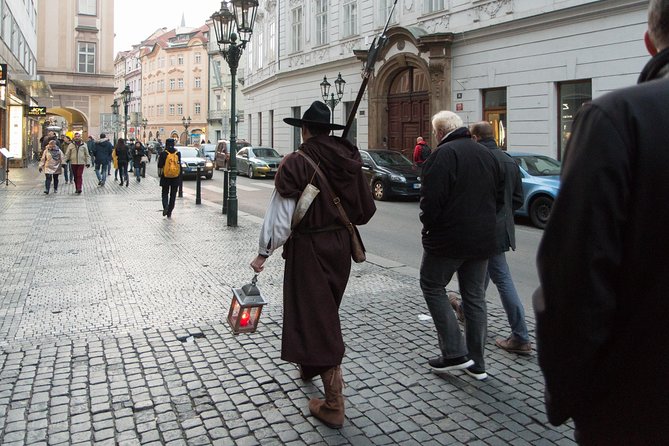
Your guide appears in historical dress and may carry a lantern and halberd. A horn and other props have also been part of the presentation. The strongest guides, especially Thomas, David, and Oscar, use these items without turning the walk into a costume stunt. The clothing sets the mood, while the stories explain what life and work were like in earlier Prague.
The first stop lasts about 10 minutes. Admission to the places visited is included because this is an outdoor walking tour, not a series of paid interior visits.
Other days out in Prague people book alongside this one:
- Prague: 50-Minute Sightseeing Evening Cruise
★ 4.2 · 33,780 reviews - Prague: Medieval Dinner with Unlimited Drinks
★ 4.4 · 19,847 reviews - Prague: Castle Tour with Local Guide and Entry Ticket
★ 4.6 · 10,422 reviews
Bread and market life at Ovocný trh
From the Powder Tower, you walk to Ovocný trh, the old fruit market. Here the focus shifts from fortifications and city power to food and daily life.
The guide explains the old market and what ordinary people ate. A small piece of bread, described as the bread of the common people, is offered to participants. It is a modest touch, but it helps connect the talk to something physical. Medieval history can feel distant when it is only names and dates. A simple food reference makes the subject more immediate.
This section is especially useful if you want more than Prague’s grand churches and royal buildings. The tour often focuses on the lower classes and the night watchman’s place in society. You hear about the city from the level of markets, streets, work, and danger, not only from the viewpoint of nobles.
The stop is brief, about 10 minutes, so do not expect a full food history of Prague. It works as a quick scene-setter before the walk turns toward culture, religion, and public punishment.
Mozart, Don Giovanni, and the Estates Theatre
The next stop is the Estates Theatre, one of Prague’s most memorable links to Wolfgang Amadeus Mozart. The guide takes you back to 1787, when Don Giovanni premiered here.
This is a welcome change of pace. The evening is not only about gloomy alleys and executions. Mozart’s Prague gives the tour a touch of music, theater, and city pride. You also pass the statue of Il Commendatore, a figure connected with Don Giovanni. It recalls the opera’s first Prague performance and gives the story a clear visual marker.
The guide also introduces a Czech local hero in this area. The supplied details do not name that person, so you should treat this part as a live storytelling moment rather than a fixed museum explanation. The guide may adjust the talk to the group and answer questions as you go.
You pass the first university in Central Europe as well. Again, the walk uses the streets as a chain of reminders: education, theater, religion, public power, and ordinary life all occupied the same compact center.
Thomas has been praised for answering questions and adding local facts, while Oscar is known for committing strongly to the night watchman role. That combination matters here. The tour is at its best when the guide keeps the period flavor but does not lose the thread of the real place in front of you.
Old Town Square, executions, and the Astronomical Clock
The longest stop is at the Old Town Hall and Astronomical Clock, with about 20 minutes devoted to the square. This is the tour’s main history lesson.
The square has been a market, meeting place, stage, and site of political violence. The guide discusses the town hall, the old marketplace, the defenestration, and famous executions. These subjects are dark, but they explain why Prague’s medieval center can feel more severe after nightfall.
The word defenestration refers to the act of throwing someone out of a window. Prague is strongly linked with this form of political protest, and the subject helps explain the city’s religious and political conflicts. The discussion of executions also brings public punishment into view. In earlier centuries, city squares were not just places to shop or admire architecture. They were places where authority was displayed in front of a crowd.
You will already know the square is one of Prague’s main sights. The night watchman’s approach gives you a different reason to pause. Look past the decorative façades and ask how the space functioned for people who lived and worked there. The guide’s stories help turn the square from a postcard view into a working part of the old city.
This is also the point where the theatrical style may divide opinion. If you prefer a formal lecture with precise academic detail, the jokes, props, and dramatic delivery may feel broad. If your group includes children or tired teenagers, the lively approach is a major help. One family found that a 12-year-old who had lost patience with other tours became interested once David began telling the stories.
A completely different kind of day out in Prague:
- Prague Castle 2.5-Hour Tour Including Admission Ticket
★ 4.7 · 8,927 reviews - Prague: Oldtown, Medieval Underground & Dungeon History Tour
★ 4.2 · 8,244 reviews - Prague: Vltava River Night Cruise with Buffet
★ 4.3 · 7,338 reviews - Prague: Panoramic Vltava River Cruise
★ 4.1 · 7,311 reviews
Jan Hus and the Hussite story
The walk continues to the Jan Hus Monument, where you spend about 10 minutes with Prague’s religious reform movement.
Jan Hus was a major Czech religious figure from the late medieval period. The monument gives the guide a place to explain the Hussites and their importance in Prague. This section adds needed context to the city’s later political conflicts and to the mood of the Old Town Square.
The tour does not treat history as a clean line from one famous man to another. It connects belief, power, class, and public life. That is one of the walk’s strengths. You get a sense of how religious arguments could affect the whole city, not just church officials.
The stop is outdoors and admission is free. Bring shoes that feel secure on stone paving. The route is not described as strenuous, but you are on your feet for roughly an hour and a half, with no seated transport.
The Týn Church and Prague’s medieval skyline
At the Church of Our Lady before Týn, the guide spends about five minutes introducing one of the oldest churches still found in Prague. The present Týn Church dates from 1368.
You may already recognize its twin towers from photographs of Old Town Square. At night, the building takes on a sharper outline, and the short stop gives you just enough context to understand its age and importance.
Do not expect an interior visit. The tour passes the church and discusses it from outside. That keeps the walk moving, but it also means you will want to return in daylight if seeing the inside matters to you.
This is a good example of the tour’s overall format. It offers context rather than a full guided visit at each landmark. You see many places in one evening, then can choose which ones deserve a longer visit later.
A quiet break beside the Rudolfinum
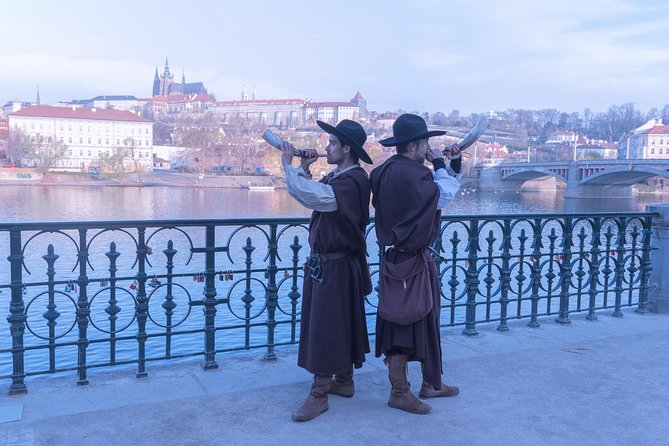
The route then reaches the Rudolfinum, the grand concert hall and art building beside the Vltava River. The group takes a break at a quieter riverside spot for about 15 minutes.
This pause is important. A nonstop history talk can become a blur, especially after several centuries of names and conflict. Here you have time to take photographs, catch your breath, and look toward Prague Castle across the river.
The castle view is one of the most practical highlights of the route. You get a fine night view without paying for an attraction or leaving the center. The riverside stop also gives the tour a calmer middle section after the heavier stories of markets, political violence, and executions.
The break is not a meal stop, and no transport is provided. If you need water or a snack, plan ahead. The supplied details do not promise refreshments beyond the bread offered earlier.
Charles Bridge and the nobles across the river
The tour ends at the Charles IV statue near the beginning of Charles Bridge. The final 15 minutes focus on Charles IV and the nobles who lived on the other side of the river.
This ending works well because Charles Bridge is one of Prague’s essential evening sights. You finish beside it rather than being left in a distant neighborhood. From here, you can continue across the bridge, walk toward the castle district, or remain in Old Town.
The guide’s closing discussion helps frame the river as more than a scenic divide. It separated parts of the city and marked differences in status and power. The talk about nobles provides a final contrast with the earlier focus on common people and the night watchman’s position.
The end point is listed as the Charles IV Statue at Křižovnické náměstí. Since there is no hotel return, you should be comfortable finding your own way afterward. Some guides, including Thomas, have helped people orient themselves after the walk, but that should be viewed as a kindness rather than a promised transfer.
Why the guides make or break the evening
This experience depends heavily on the person leading it. The most praised quality is not simply factual information. It is the guide’s ability to tell a story, hold a character, and keep the group involved.
Thomas is repeatedly described as funny, engaging, and full of local facts. He has used a horn, a large beard, and other touches that make the night watchman persona easy to remember. David is praised for clear English, humor, detailed explanations, and an ability to bring children into the story. Oscar is described as quirky and fully committed to the role.
Small groups add to the effect. A departure with three or four people can feel almost private. The guide may learn your names, ask where you are staying, answer more questions, and offer practical tips for getting around Prague. The maximum is 15, so even a full group remains fairly contained.
The tradeoff is that the experience may vary with the guide and group. A theatrical presentation will not suit everyone. You should book this if you like storytelling, period costumes, and a little grim humor. If you want a strict chronological lecture or detailed architectural analysis, choose a more traditional city walk instead.
Price, timing, and who gets the best value
At $26.62, this is reasonably priced for a 90-minute guided walk in central Prague. You are paying for a guide in historical dress, a planned route, local taxes, and a focused performance. There are no entrance fees to recover, so the value rests almost entirely on the quality of the storytelling.
I think it offers the best value on your first or second evening in Prague. The route gives you a useful map of the Old Town, then ends at Charles Bridge, where you can continue exploring. It also works well after a daytime city tour because the night watchman follows a different angle, with more attention to daily life, public danger, and street-level stories.
Book ahead if your schedule is fixed. The experience is booked an average of 26 days in advance, which suggests that popular dates can fill before your arrival. You receive confirmation when booking, and free cancellation is available if you cancel at least 24 hours before the start time. Cancellations inside that window are not refunded, and the tour needs a minimum number of participants to operate.
The walk runs in all weather. Wear a warm layer, rain protection when needed, and comfortable shoes. Children must stay with an adult, and a moderate level of physical fitness is expected.
Is this the right Prague evening tour for you?
I would choose this walk if you want Prague’s famous sights with more personality than a standard orientation tour. It is especially good for families, teenagers, first-time visitors, and anyone who enjoys local stories with a dark edge.
I would think twice if you dislike role-play, already know the Old Town’s history in detail, or need frequent indoor seating. The route is outdoors, the talk can be dramatic, and several subjects involve executions and troubled political periods.
For most visitors, the price is sensible and the ending is convenient. Book it for the character, the stories, the small-group feel, and the chance to see Prague after dark. Skip it only if you want a quiet, purely architectural walk with no theatrical flourishes.
FAQ
How long does the Medieval Prague Through a Nightwatchman’s Eyes tour last?
The tour lasts approximately 1 hour and 30 minutes.
Where does the tour begin?
It begins at the Powder Tower, Náměstí Republiky 5, Staré Město, Prague 1.
Where does the tour end?
It ends at the Charles IV statue at Křižovnické náměstí, at the beginning of Charles Bridge.
Is the tour offered in English?
Yes. The experience is offered in English and includes a guide in historical dress.
Does the tour operate in bad weather?
Yes. It operates in all weather conditions, so you should dress appropriately.
What is the cancellation policy?
You can cancel at least 24 hours before the start time for a full refund. Cancellations or changes made less than 24 hours before the start time are not refunded or accepted.
Just added around Prague
- Private Day trip from Prague to Kutná Hora★ 5.0 · 3 reviews
- PRAGUE AIRSOFT SHOOTING GAMES★ 4.7 · 3 reviews
- Private 4-hour City Tour of Prague with driver & official guide w/ Hotel pick up★ 5.0 · 3 reviews
- Glass blowing in Prague★ 4.6 · 3 reviews
- Prague to Karlovy Vary Private Transfer★ 4.5 · 3 reviews
- Disney’s Tarzan Musical★ 5.0 · 3 reviews
- Prague Private Tour★ 5.0 · 3 reviews
- Private Bohemian Glass and Czech Crystal Tour with lunch included★ 5.0 · 3 reviews