
REVIEW · PRAGUE
Back In Time: Zážitkové muzeum historie
Prague’s past gets a playful reboot. Back In Time Prague turns Czech history into interactive scenes, with medieval life, Renaissance settings, royal stories, and modern effects that help you get your bearings before sightseeing around the city. I like the mix of the time machine and the 5D cinema, which gives children a reason to pay attention when dates and names alone might not hold them.
I also like the clear family focus and the short, one-hour format. The main consideration is that the history may feel light on detail, especially if you want a serious museum lesson rather than an entertaining introduction. One Polish visitor praised the organization but found the storytelling and amount of content limited, a useful warning for history buffs.
In This Review
- Key points to know before you go
- What Back In Time Prague is really offering
- The time machine begins your trip through Prague’s past
- Libuše and the founding of Prague
- The Golem brings Prague’s folklore to life
- Charles IV gives the royal era a human face
- The Astronomical Clock gets a story, not just a photo
- The Prague Uprising adds a harder chapter
- Why the 5D cinema matters
- A good fit for children, schools, and short attention spans
- How much value do you get for $18?
- How to fit this into a Prague day
- Who should book Back In Time Prague?
- Should you book it?
- FAQ
- How long does Back In Time Prague last?
- How much does admission cost?
- What is included in the experience?
- What age can children enter?
- Is the experience wheelchair accessible?
- Is the 5D cinema suitable for everyone?
- Can I cancel my booking?
Key points to know before you go
- The 5D cinema adds physical effects and turns Prague’s past into a more active show than a standard museum display.
- The time machine links several eras including the Middle Ages, the Renaissance, and the age of Charles IV.
- Prague legends get their own treatment, including the Golem and the story of Libuše founding the city.
- The visit lasts about one hour, making it easy to fit into a busy Prague day.
- Children must be at least six years old and taller than 110 centimeters, with important restrictions for epilepsy, claustrophobia, pregnancy, and heart disease.
- The $18 price is reasonable for families who value entertainment and a quick history primer, but less appealing if you want extensive historical explanation.
What Back In Time Prague is really offering
This is not a traditional museum built around long labels, glass cases, and quiet contemplation. It is an experience museum, designed to put you inside short scenes from Prague and Czech history.
You move through a sequence of interactive exhibits and reconstructed settings. Modern technology supplies movement, sound, and visual effects, while the subjects come from familiar parts of the city’s past. You can expect references to medieval Prague, the Renaissance, Charles IV, the Astronomical Clock, the Prague Uprising, and the old legend of the Golem.
I see the attraction as a first layer of history. It can give you names and stories to recognize when you later walk across Charles Bridge, visit Old Town Square, or look up at the Astronomical Clock. It does not appear designed to replace a detailed historical museum or a guided city walk.
That distinction matters. If you want a fast, lively introduction, the format works well. If you already know Prague’s history and want rare objects, long explanations, or careful historical debate, you may find the content too brief.
Other days out in Prague people book alongside this one:
- Prague: 50-Minute Sightseeing Evening Cruise
★ 4.2 · 33,780 reviews - Prague: Medieval Dinner with Unlimited Drinks
★ 4.4 · 19,847 reviews - Prague: Castle Tour with Local Guide and Entry Ticket
★ 4.6 · 10,422 reviews
The time machine begins your trip through Prague’s past
The time machine is the central idea holding the visit together. Rather than presenting the city’s history as one long lecture, it lets you move between important periods and see how Prague changed over time.
You can expect the early part of the visit to establish the setting and lead you toward scenes from the Middle Ages and Renaissance. These periods are especially useful for first-time visitors because they provide context for the architecture you see outside. Prague’s old streets, churches, towers, and courtyards make more sense when you know that the city developed through several distinct eras.
The strength here is speed. In about an hour, you get a broad outline without spending half a day indoors. I would treat this portion as a preview rather than a full lesson. The attraction gives you enough to spark curiosity, but you should not expect a detailed timeline or extended explanations at every stop.
For children, the time-machine concept gives the visit a simple story. They are not just moving from one display to another. They are being carried from one period to the next, which can make the material easier to follow.
Libuše and the founding of Prague
The story of Libuše adds a legendary beginning to the visit. Libuše is connected with the traditional founding of Prague, so this section presents the city through myth and cultural memory rather than through a strictly documented account.
That is valuable because Prague is a city where legend is part of the sightseeing experience. Stories help explain why certain places have such a strong place in local imagination. You may not leave with a scholarly account of early Prague, but you should gain a memorable story to connect with the city itself.
I appreciate the inclusion of this subject because it avoids presenting Czech history as only a list of rulers and dates. A good introduction also shows how people have told stories about their city. Still, you should keep the distinction in mind: a legend and a verified historical event are not the same thing.
The Golem brings Prague’s folklore to life
The legend of the Golem is another highlight for families. This famous Prague story brings mystery and drama into the visit, and it is likely to be easier for younger children to remember than a string of royal names.
The Golem also gives you a reason to pay attention to Prague’s Jewish history and the stories connected with the old Jewish quarter. The attraction’s information does not indicate how extensively that wider subject is explained, so I would not treat this section as a full introduction to Jewish Prague.
Instead, see it as a starting point. If the story catches your interest, you can continue with a visit to the Jewish Museum area and learn more from dedicated historical sites. Back In Time Prague makes the legend accessible, especially for a family that wants a shared story before exploring the city on foot.
A completely different kind of day out in Prague:
- Prague Castle 2.5-Hour Tour Including Admission Ticket
★ 4.7 · 8,927 reviews - Prague: Oldtown, Medieval Underground & Dungeon History Tour
★ 4.2 · 8,244 reviews - Prague: Vltava River Night Cruise with Buffet
★ 4.3 · 7,338 reviews - Prague: Panoramic Vltava River Cruise
★ 4.1 · 7,311 reviews
Charles IV gives the royal era a human face
The section on King Charles IV focuses not only on his importance but also on what his real life was like. That personal angle can make a ruler easier to understand. Instead of thinking only about buildings and political achievements, you get an invitation to consider the person behind the title.
Charles IV is a key figure in Prague’s development, so this subject helps connect the museum with major city sights. The experience can give you a reason to look more closely at the places associated with his reign when you continue sightseeing.
The tradeoff is depth. The available description promises a look at his life, but it does not provide a full account of how long this section lasts or how much detail it contains. I would expect a concise, theatrical treatment rather than a complete biography.
That is fine for families and school groups needing a memorable introduction. Adults with a strong interest in medieval politics may want to follow it with a proper museum visit or a history book.
The Astronomical Clock gets a story, not just a photo
Many people visit Old Town Square, take a picture of the Astronomical Clock, and move on without understanding what they are seeing. The museum’s section on the clock is useful because it promises the founding story and the real account behind this Prague landmark.
This is one of the most practical parts of the visit for first-time visitors. Afterward, you can look at the clock with more curiosity. You may notice its age, purpose, and place in the city’s public life rather than seeing it as only a decorative attraction.
The wording about the real story suggests a contrast between popular tales and historical explanation. Since the overall visit is short, I would expect a compact version, not an exhaustive technical account of the clock’s construction and repairs.
Even so, a short explanation can improve your later sightseeing. A landmark becomes more interesting when you understand why it was built and what it meant to the people who lived around it.
The Prague Uprising adds a harder chapter
The Prague Uprising brings the visit into a more recent and serious period. Including it prevents the attraction from stopping with kings, legends, and old city views. It reminds you that Prague’s story also includes conflict, resistance, and difficult modern events.
This section may be especially useful for school groups because it widens the time span. Children can see that history is not only about castles and famous rulers. It also involves ordinary people responding to danger and political change.
The supplied information does not explain the exact presentation or level of detail, so I would avoid expecting a complete account of the uprising. The benefit is the broad sweep. You receive a short route through several major themes, from legend to royal power to modern conflict.
Parents and teachers should be ready to add context afterward. The museum can open the subject, but a one-hour attraction cannot cover every cause, event, and consequence in depth.
Why the 5D cinema matters
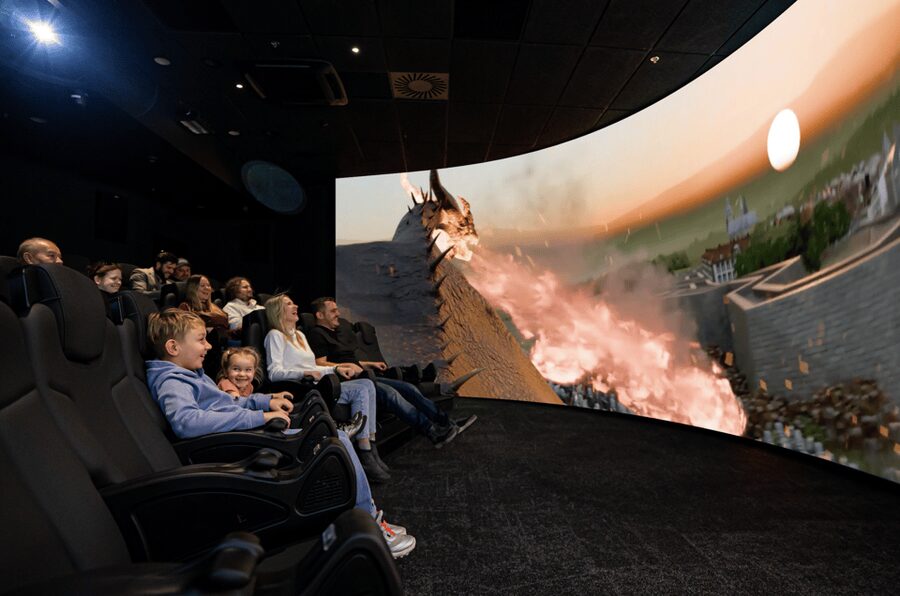
The 5D cinema is the attraction’s main burst of adrenaline. The screen is designed to feel active, with effects that make the scene seem to come toward you rather than remain flat in front of you.
For children, this is likely the most immediately exciting section. It breaks up the historical material and gives the visit a clear entertainment element. A family can enjoy the show together, then talk about the historical setting afterward.
The effects also explain the safety rules. People with epilepsy, claustrophobia, or heart disease are not permitted to enter, and pregnant women are listed among those for whom the attraction is not suitable. Children must be at least six years old and taller than 110 centimeters, or about 3 feet 7 inches.
You should take those restrictions seriously. This is not simply a quiet film in a regular cinema seat. If you or someone in your party may be affected by enclosed spaces, strong stimulation, or motion effects, this may not be the right choice.
A good fit for children, schools, and short attention spans
The strongest praise in the available feedback is directed at children. A United States visitor described it as amazing for kids, while a French-language comment specifically recommended it for families with children. That matches the design: short scenes, physical effects, legends, and familiar figures give young visitors several ways to stay engaged.
I would choose it for a family that wants one indoor activity during a Prague visit. It can also work well at the beginning of your stay, when you are still learning who Libuše, Charles IV, and the Golem are.
Schools can use the attraction as a supplement to classroom teaching. The material covers several periods and includes both legend and documented history. Teachers should plan to discuss the themes before or after the visit because the one-hour format cannot provide all the background on its own.
The age rules narrow the audience. Children under six cannot enter, and height matters as well. A child who meets the age requirement but is shorter than 110 centimeters will still be excluded.
How much value do you get for $18?
At $18 per person, the price makes the most sense when you judge it as a family activity, not as a full museum admission. A family pays for a compact blend of exhibits, theatrical scenes, and a 5D presentation.
I think the value is good if you want entertainment with a historical purpose. The experience may keep children interested for an hour, and it can give you useful background before exploring Prague’s streets.
The calculation changes if you are a serious history enthusiast. The Polish rating praised the organization but criticized the limited storytelling and small amount of content. That is the clearest warning about value. You may feel that $18 is high if you expect long explanations, rare artifacts, or enough material for a half-day visit.
The free cancellation up to 24 hours before the scheduled time and the option to reserve without paying immediately reduce the risk of fitting it into a changing itinerary. The attraction is also wheelchair accessible, which makes it easier for many families and school groups to consider.
How to fit this into a Prague day
The one-hour duration is the attraction’s biggest practical advantage. You can place it between major sightseeing stops without giving up an entire morning or afternoon.
I would schedule it when your group needs a change of pace. After several churches, towers, or historical interiors, children may welcome something with movement and sound. On a rainy day, it can provide an indoor break while still keeping your plans focused on Prague.
You should not count on this single visit to explain every sight in the city. Use it as a short orientation, then connect each subject with the real places around Prague. The Astronomical Clock, Charles IV’s legacy, the old city, and local legends all become more meaningful when you encounter them again outside the museum.
Because the experience is only an hour, you may want to plan another activity nearby. The supplied information does not specify the exact address, entry procedure, or group size, so check the current starting times and meeting details when booking.
Who should book Back In Time Prague?
I would recommend it most strongly to families with children aged six and above who want history presented in a lively way. It is also a sensible pick for school groups and first-time visitors who need a quick introduction before seeing Prague’s major sights.
You should consider it if you like:
- Short indoor activities
- Interactive exhibits instead of long text panels
- Legends mixed with historical events
- A 5D film with physical effects
- Family-friendly ways to introduce children to Czech culture
I would be more cautious if you want academic detail, a long visit, or a collection of original objects. The attraction’s appeal is its presentation, not the amount of information it can cover.
Should you book it?
Book Back In Time Prague if you want a fun one-hour history primer and your group includes children who respond better to action than to labels. The time machine, Golem legend, Charles IV section, Astronomical Clock story, and 5D cinema give you a varied visit at a manageable length.
Skip it if you are looking for a serious museum study or already know Prague’s history well. The strongest evidence points to good organization and strong appeal for children, but also to limited storytelling and limited content. For the right audience, $18 buys an enjoyable introduction. For a dedicated history student, it may feel more like a trailer than the full film.
FAQ
How long does Back In Time Prague last?
The experience lasts approximately one hour.
How much does admission cost?
The listed price is $18 per person.
What is included in the experience?
Admission includes interactive exhibits, a 5D cinema experience, a time machine, the legend of the Golem, the founding of Prague by Libuše, the life of King Charles IV, a Hall of Fame, the history of the Astronomical Clock, and the Prague Uprising.
What age can children enter?
Children must be at least six years old. Visitors must also be taller than 110 centimeters.
Is the experience wheelchair accessible?
Yes, the experience is wheelchair accessible.
Is the 5D cinema suitable for everyone?
No. Entry is prohibited for people with epilepsy, claustrophobia, or heart disease. Pregnant women are also listed as unsuitable for the experience.
Can I cancel my booking?
You can cancel up to 24 hours in advance for a full refund. You can also reserve now and pay later.
Just added around Prague
- Private Day trip from Prague to Kutná Hora★ 5.0 · 3 reviews
- PRAGUE AIRSOFT SHOOTING GAMES★ 4.7 · 3 reviews
- Private 4-hour City Tour of Prague with driver & official guide w/ Hotel pick up★ 5.0 · 3 reviews
- Glass blowing in Prague★ 4.6 · 3 reviews
- Prague to Karlovy Vary Private Transfer★ 4.5 · 3 reviews
- Disney’s Tarzan Musical★ 5.0 · 3 reviews
- Prague Private Tour★ 5.0 · 3 reviews
- Private Bohemian Glass and Czech Crystal Tour with lunch included★ 5.0 · 3 reviews